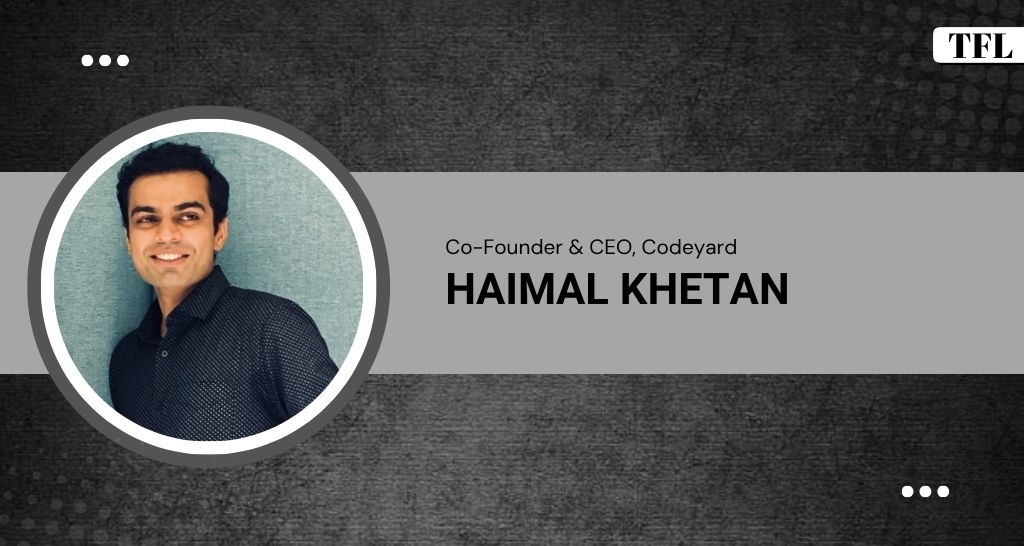
When Haimal Khetan started Codeyard in 2019, it didn’t begin in a flashy office or with venture capital backing. It started in a small room, with limited resources, a laptop, and a clear frustration he had seen play out repeatedly around him. Friends, family members, and businesses would invest in websites or applications, only to be left disappointed months later — broken systems, poor performance, and technology that failed the moment it was put to real use.
“Technology should make life easier, not more complicated. If it doesn’t scale, perform, and last — it’s already broken.”
For Haimal, the problem wasn’t ambition or ideas. It was execution.
Before founding Codeyard, Haimal worked closely in the startup environment where he gained hands-on exposure to technology, scalability, and the realities of building digital systems that need to grow. That experience shaped his understanding of how fragile poorly built technology can be — and how powerful well-designed systems become over time. He saw firsthand that most businesses don’t fail because they lack vision, but because the technology supporting them is unreliable.
That insight became the foundation of Codeyard.
“I kept hearing the same complaint everywhere — the website doesn’t work properly, the app breaks, nothing scales,” Haimal recalls. “So we set out with a simple mission: deliver quality software and products at honest pricing, always.”
From Services to Systems
Codeyard began by building websites and software solutions for people close to Haimal — friends, family, early clients — and grew steadily through word of mouth. The focus from day one was not volume, but reliability. That approach led to strong client retention and long-term relationships, eventually earning Codeyard recognition as a Shopify Expert Partner and a Wix Studio Legend Partner.
But for Haimal, services were never the end goal.
“Services help you understand problems deeply,” he explains. “But products help you solve those problems at scale.”
Today, Codeyard operates as a product-driven technology company that builds high-quality SaaS platforms, Wix and Shopify templates, apps, and digital products — supported by services in web development, e-commerce, SEO, AI Engine Optimization, and digital growth. The services arm acts as a feedback loop, continuously informing product decisions with real-world data and real client needs.
One of Codeyard’s flagship product directions includes SaaS platforms for the medical industry, alongside marketplace-ready templates and apps for Wix and Shopify. The company is also actively developing AI-powered tools designed to improve productivity and simplify workflows rather than replace people.
“AI isn’t here to replace us,” Haimal says. “It’s here to make us more efficient, more productive, and more focused on meaningful work.”
A Leadership Style Built on Ownership
Haimal’s leadership philosophy is deeply rooted in ownership and long-term thinking. He believes that founders and leaders must understand the technology they build — not just manage teams around it. At Codeyard, quality is non-negotiable, regardless of whether the output is a SaaS platform, a template, or a client project.
Another defining principle is accessibility without compromise.
“There’s a misconception that affordable software has to be bad software,” he explains. “That’s simply not true. With the right systems, discipline, and experience, you can deliver high-quality technology that’s still accessible.”
Both Haimal and his co-founder, Binesh, bring more than a decade of experience in the tech industry. That depth allows Codeyard to avoid shortcuts and focus on stability, performance, and scalability — areas where many digital projects fail silently over time.
The Build–Operate–Transfer Model
As Codeyard grew, Haimal faced a challenge common to many founders: how to scale without becoming the bottleneck. The solution came in the form of a Build–Operate–Transfer model.
“I’m naturally drawn to new ideas and new challenges,” he says. “I enjoy researching problems, validating ideas, and building systems to a stable point.”
Under this model, Haimal personally drives the early stages of new initiatives — ideation, validation, and initial execution. Once a product or system reaches stability, ownership is transferred to capable leaders within the organization, allowing teams to scale independently while he steps back into a strategic oversight role.
This approach has enabled Codeyard to remain agile while continuously innovating, without sacrificing operational consistency.
Scaling with Intent
Looking ahead, Codeyard’s goals are ambitious but grounded. In the short term, the company is focused on launching multiple new products across SaaS, marketplace templates, and AI-driven tools. To support this growth, Codeyard is actively hiring and building dedicated product teams.
In the long term, Haimal is clear about the direction: scale, profitability, and global impact — without losing execution quality.
“We want Codeyard to be known as a company that ships useful products consistently,” he says. “Not experiments that break, but systems people can rely on.”
Rather than chasing trends, Codeyard’s strategy centers on identifying real gaps in industries and building solutions that simplify complexity. Whether it’s healthcare platforms, AI-powered productivity tools, or e-commerce infrastructure, the focus remains the same: make technology work quietly and reliably in the background.
Advice for the Next Generation
For emerging entrepreneurs and leaders, Haimal’s advice is refreshingly direct.
“Don’t confuse hype with progress,” he says. “Build things that work. Learn the technology deeply. Stay close to your users. And don’t rush scale before stability.”
In an industry that often rewards speed over substance, Haimal believes discipline and execution remain the most underrated advantages.
A Vision Beyond 2026
As Codeyard continues to expand its global footprint, Haimal envisions the company becoming a quiet but powerful force behind thousands of businesses worldwide. Through SaaS platforms, templates, apps, and AI-driven systems, Codeyard aims to remove friction from how people use technology.
“If we do our job right,” he reflects, “people won’t think about the technology — they’ll just trust it.”
In a digital landscape crowded with promises, Codeyard’s story stands out for its simplicity: build quality, scale responsibly, and never forget that technology exists to serve people, not frustrate them.
That philosophy may be understated — but it’s precisely what makes Haimal Khetan one of Asia’s most influential business leaders to watch in 2026.
📌 Visit Haimal Khetan 👉 – LinkedIn Profile
🌐 Explore Codeyard 👉 – Company Website