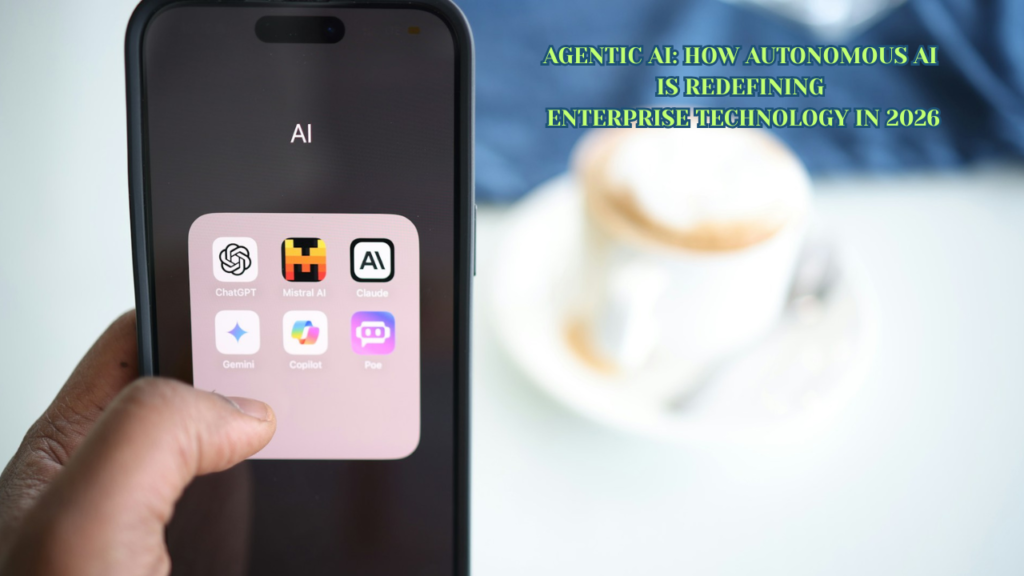
In 2026 artificial intelligence is reaching a new stage at which it does not merely answer questions, generate content or analyse information but is instead becoming capable of taking action. This change is due to agentic AI, a technology which enables AI agents to plan tasks, make decisions, use digital tools and carry out workflows with only limited human involvement.
The most significant change for businesses is shifting from using AI as an assistant to having AI take an active role in business operations. Unlike traditional automation which works according to fixed rules, agentic AI is able to evaluate a situation, decide on the next steps needed, and modify its approach when the circumstances change. For instance, an AI agent might keep an eye on a supply chain, spot a possible delay, get in touch with the appropriate suppliers, update the internal systems, and notify a manager whenever human approval is needed.
The ability to do this is also having an impact on enterprise software. Nowadays, businesses are incorporating AI agents into fields including customer service, finance, cybersecurity, human resources, sales, IT support, and supply-chain management. Rather than staff members having to switch from one application to another in order to carry out routine tasks, the agents are now able to connect these systems and take care of various stages of a process themselves.
Another significant advancement is that of multi-agent systems. Instead of depending on a single AI system to carry out all tasks, businesses can make use of specialised agents, each taking on different responsibilities. The agents are able to work together, share information, and coordinate their activities in order to achieve a general business objective.
Since greater autonomy also means greater responsibility, companies must have strong security measures, proper access controls, monitoring systems, and definite rules stating what an AI agent can and cannot do. If the data is of poor quality or the agent is incorrectly configured, it may result in expensive mistakes. It is therefore necessary to maintain human oversight, especially when it comes to financial, legal, security, and other significant decisions.
In 2026 the true value of agentic AI won’t be found in just using more AI, but will result from applying autonomous systems to deal with real business problems while at the same time keeping control and ensuring accountability. Those companies which combine capable AI agents with reliable data, careful governance, and human judgment are likely to benefit most from this new technology.