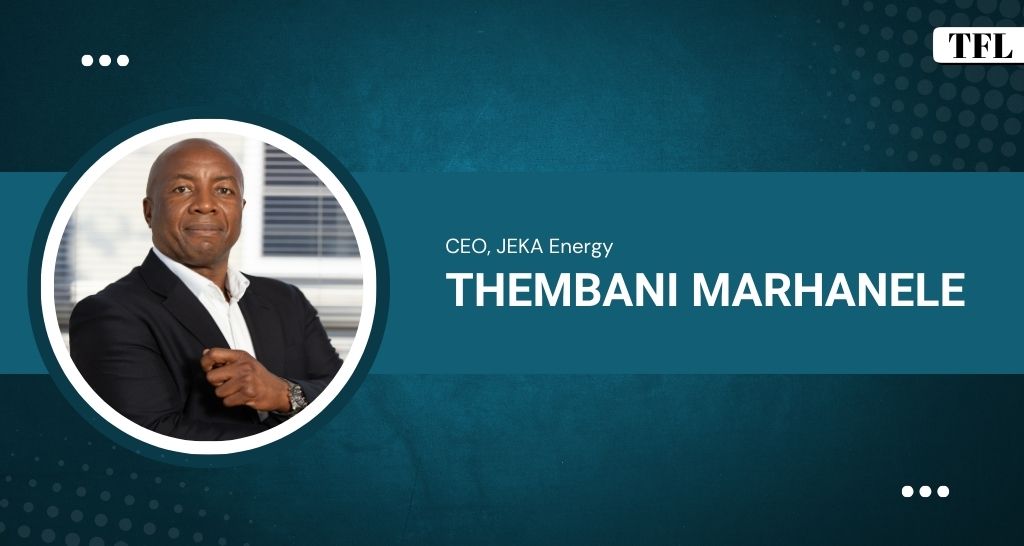
On the sun-scorched plains and fast-growing cities of Africa, the future of energy is no longer a distant promise. It is being actively designed, debated, and deployed by leaders who believe that clean power must do more than light homes or fuel industries it must transform lives. At the center of this movement stands Thembani Marhanele, CEO of JEKA Energy, a renewable energy developer championing what he calls a Just Energy Transition one that places communities at the heart of Africa’s green future.
Marhanele’s leadership is not driven by abstract climate goals or imported solutions. Instead, it is grounded in lived experiences, global training, and a deep conviction that Africa’s energy transition must be inclusive, locally rooted, and socially transformative.
From Global Learning to African Purpose
Marhanele’s professional journey into renewable energy is shaped by both international exposure and a distinctly African worldview. In 2019, he earned certification as an International Renewable Energy Project Developer through the Renewables Academy in Berlin, Germany. A year later, he further specialized as a Country COBENEFITS Specialist in Renewable Energy, focusing on aligning clean energy projects with socio-economic benefits. In parallel, he was trained as a Climate Reality Leader by Al Gore in 2020, strengthening his global perspective on climate action.
Yet, for Marhanele, these credentials were never about personal advancement. They were tools means to an end. His true motivation lies in a passion for preserving Planet Earth while ensuring that Africa’s transition to clean energy delivers tangible, inclusive socio-economic benefits.
Renewable energy, in his view, is not just a technical solution. It is a moral imperative and an opportunity to correct long-standing inequalities in access to power, opportunity, and participation.
A Vision Rooted in Justice
At the core of Marhanele’s leadership philosophy is a simple but radical idea: a Just Energy Transition must be truly just. For JEKA Energy, this means communities are not passive recipients of renewable energy projects. They are active participants from concept and adoption to implementation and long-term operation. This approach aligns directly with the United Nations Sustainable Development Goals, particularly those related to affordable, clean, and safe energy access.
Marhanele believes that energy projects imposed on communities, without consultation or inclusion, are destined to fail socially even if they succeed technically. His vision insists on dignity, ownership, and shared value creation as non-negotiable pillars of renewable development.
Challenging Traditional Industry Thinking
Advancing this vision has not been without resistance. One of the most significant challenges Marhanele has faced is persuading traditional partners and original equipment manufacturers (OEMs) to support community-focused initiatives. Many preferred conventional sponsorship models that offer visibility but little structural change.
Rather than compromise his principles, Marhanele chose a different route. JEKA Energy partnered with non-profit organizations and began self-funding initiatives through its innovative Second Chance Program. Instead of asking suppliers for donations, JEKA invited them into the value chain offering participation, collaboration, and shared impact. This shift reframed community development not as charity, but as smart, sustainable business aligned with long-term project success.
Innovation Beyond Technology
While renewable energy is often discussed in terms of megawatts and efficiency curves, JEKA Energy’s innovation lies just as much in its social architecture as in its technical solutions. The company hosts energy forums within communities, creating spaces for dialogue, education, and preparation. These forums introduce renewable technologies while also explaining the roles communities can play across the value chain from installation and maintenance to administration and local entrepreneurship.
Training programs are designed to capacitate participants to engage meaningfully with new technologies and emerging opportunities. For Marhanele, innovation means ensuring that people are not left behind by technological progress, but are empowered to lead it.
Transforming Communities Across Borders
JEKA Energy’s impact is not confined to one country. Under Marhanele’s leadership, the company operates across Zambia, Zimbabwe, Botswana, and Lesotho, adapting its community-centric model to diverse local contexts.
In each market, the goal remains the same: enable communities to participate meaningfully and sustainably in renewable energy projects deployed in their regions. Beyond grid-scale developments, JEKA also donates, installs, and operates off-grid systems for communities in need bringing power to places long excluded from energy access. These initiatives do more than provide electricity. They unlock education, healthcare, entrepreneurship, and dignity key drivers of Africa’s sustainable growth.
Technology as a Catalyst for Jobs and Education
Marhanele sees technology as a powerful enabler of both environmental and social progress. Advancements in areas such as waste-to-energy are helping address environmental challenges while creating cleaner communities.
More importantly, these technologies are generating much-needed jobs and inspiring youth to become champions of the Just Energy Transition. By integrating education and skills development into project deployment, JEKA Energy ensures that technological adoption translates into long-term human capital growth. In Marhanele’s Africa, innovation is measured not only by efficiency gains, but by how many lives are uplifted along the way.
Collaboration as a Cornerstone
Large-scale renewable adoption, Marhanele argues, cannot be achieved in silos. Governments, NGOs, private sector players, and communities must all have an equal seat at the table.
From policy formulation and technology adoption to industry advancement and project execution, every stakeholder brings lessons that can strengthen the collective outcome. This collaborative mindset is central to modeling an energy transition that is not only fast, but fair. For Marhanele, inclusion is not a courtesy it is a strategic necessity.
Designing for Longevity
Sustainability, in JEKA Energy’s model, extends far beyond environmental metrics. The company invests heavily in long-term project viability by forging strong relationships with OEMs and extensively training local teams on their technologies.
JEKA’s role does not end at project commissioning. The company remains involved throughout the project lifecycle, providing localized support and participating in funding structures through Jeka Capital, including power purchase agreements. This long-term commitment ensures resilience, accountability, and sustained community benefit.
Advice for Africa’s Next Energy Leaders
To aspiring leaders eager to shape Africa’s renewable future, Marhanele’s advice is direct: get involved now, without hesitation. He encourages deep research into the renewable energy value chain, clarity on one’s role within it, and active collaboration to build ecosystems that support shared success. His guiding belief is simple yet profound: good money follows good deeds. Purpose, when aligned with competence and collaboration, becomes a powerful force.
An African Future, Built in Africa
Looking ahead to the next decade, Marhanele envisions localized manufacturing plants producing key components for solar, wind, hydrogen, and waste-to-energy systems across the continent. Such an ecosystem would accelerate deployment, reduce costs, and create industrial jobs at scale. More than infrastructure, he dreams of a movement one where all stakeholders champion equal rights and access to basic needs with urgency and unity.
Leading with Humility and Humanity
Despite his achievements, Marhanele remains grounded. Extensive travel across Africa has humbled him, exposing him to communities rich in resilience, stories, and smiles often in places with very little material wealth.
JEKA Energy, he says, exists as a conduit for those often forgotten: youth, women, people with disabilities, retirees, and young professionals. By recruiting, training, and employing community members, the company helps break cycles of exclusion and redefines purpose for both the organization and the individuals it serves. Proudly African, Thembani Marhanele is shaping the energy transition the African way with justice, humanity, and shared opportunity at its core.
📌 Thembani Marhanele – LinkedIn
🌐 JEKA ENERGY – Company Website