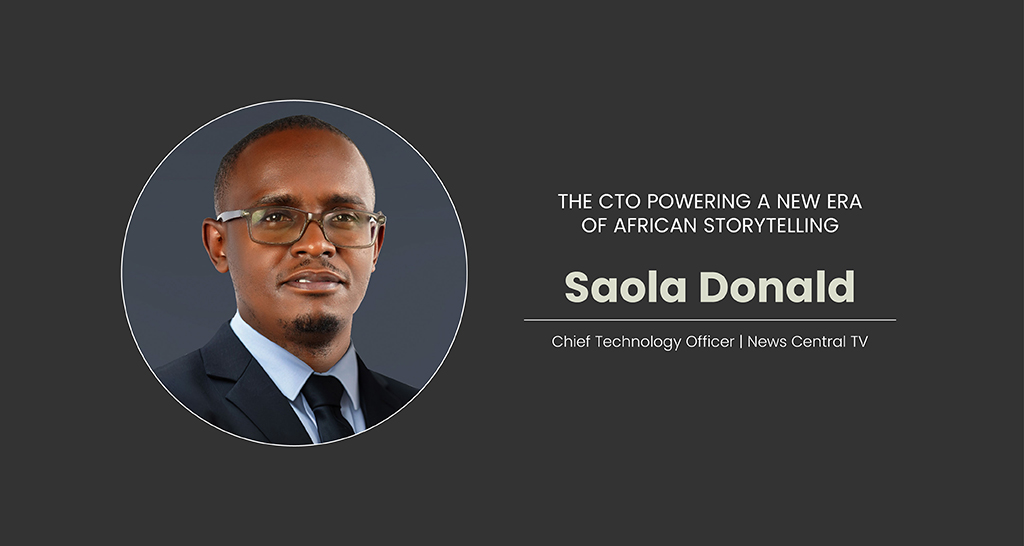
In an era where technology is reshaping how stories are told, shared, and remembered, Saola Donald stands at the forefront of Africa’s broadcast evolution. As the Chief Technology Officer of News Central TV, he represents a new wave of leaders merging engineering depth with visionary thinking champions of a media future where innovation and African narratives rise side by side. His journey from a budding engineer in Nairobi to one of the continent’s most influential CTOs is a story of purpose, transformation, and a relentless belief in the power of technology to amplify truth.
A Journey Built on Passion and Purpose
Donald’s story did not begin in a boardroom or with a grand plan to lead major media infrastructures. It began with curiosity a fascination with the mechanics of broadcast systems and the art of capturing reality through technology. Over more than 15 years, his career unfolded across the media ecosystem, moving through systems integration, broadcast infrastructure design, and digital transformation for cable networks and media giants.
From Nairobi, where he honed his early engineering instincts, to projects across East, West, and Southern Africa, Donald built a reputation for merging technical precision with creative understanding. His body of work reflected not just competence, but commitment a desire to elevate African media through global-standard systems.
This combination of skill and purpose eventually led him to News Central TV, a fast-growing pan-African news brand renowned for its bold approach to storytelling. For Donald, the opportunity represented more than a role it was a mission. “News Central is one of the few places where technology isn’t just a support function; it drives strategy, efficiency, and connection,” he reflects. Joining the organisation offered him a canvas to modernise media delivery in a rapidly evolving digital landscape, building a technology backbone that could keep pace with the continent’s shifting information needs.
Redefining News Delivery Through Technology
At News Central TV, Donald has helped redefine how audiences across Africa access news. Technology, in his view, is the bridge between vision and impact. Under his leadership, the organisation embraced cloud-based workflows, IP-first broadcast systems, and digital-native content strategies that align with modern consumption habits.
The newsroom today operates as a truly integrated ecosystem, where automation, robotic cameras, and multi-platform distribution ensure that audiences receive timely, high-quality storytelling whether on TV, mobile devices, or social platforms. Reporters from different regions across Africa contribute seamlessly to a unified production system, accelerating the delivery of breaking news and giving broader visibility to diverse African perspectives.
This shift reflects Donald’s belief that decentralised journalism, supported by smart infrastructure, is the future of the continent’s media landscape.
Innovation Rooted in Impact
Among the many projects Donald has spearheaded, several stand out not just for their ambition, but for their measurable impact on operations and audience engagement.
One of the most transformative was News Central’s migration to a cloud-enabled newsroom ecosystem. The result was a streamlined environment where news gathering, editing, and publishing moved faster and more collaboratively than ever before. Production bottlenecks diminished, and field reporters became more empowered and agile.
Donald also introduced AI-supported systems for content tagging and recommendation technology that ensures audiences encounter relevant stories in real time. On the broadcast front, IP-based contribution tools replaced traditional satellite-dependent workflows, enabling live reports from across the continent with greater flexibility and significantly lower costs.
Interactive graphics engines and data-driven visual tools further elevated the network’s on-air experience, particularly in political, business, and election coverage. This integration of advanced graphics and storytelling has positioned News Central among Africa’s most forward-thinking broadcast brands.
Harnessing AI, Data, and Automation Responsibly
As global media undergoes dramatic transformation, Donald has championed the strategic use of AI, analytics, and automation technologies he sees not as disruptors, but as amplifiers of journalistic excellence.
AI now supports transcription, translation, and noise-reduction processes within the newsroom, accelerating content production. Data analytics plays a central role in shaping editorial choices, helping teams understand audience behaviour, refine storytelling formats, and optimise distribution strategies.
Automation has brought consistency and reliability to the broadcast chain, from playout to studio operations. Yet Donald insists that technology must never erode the human essence of storytelling. Every automated process includes human checkpoints to protect accuracy, integrity, and editorial values.
Balancing Innovation with Africa’s Realities
Despite the remarkable progress, Donald’s role is not without challenges. Working across Africa requires navigating connectivity limitations, power inconsistencies, and varied regional technology standards. Designing systems that remain resilient in the face of these challenges demands creativity and adaptability.
Another challenge lies in organisational adoption. As technology evolves rapidly, ensuring teams embrace new tools requires structured training, transparent communication, and continuous engagement. Cybersecurity, too, remains a top priority in today’s interconnected media world.
Donald approaches these issues proactively through redundancy planning, strong vendor partnerships, ongoing training, and a culture that sees every challenge as an opportunity to learn and evolve.
A Milestone That Defines His Vision
Among his many achievements, the project that best reflects his leadership philosophy is News Central’s end-to-end digital transformation. He oversaw a complete reengineering of the broadcast workflow, transitioning the organisation from hardware-heavy systems to a flexible, IP-driven architecture.
Cloud-enabled ingest and editing, automated playout, and mobile-first tools for field reporters changed not just how content is produced, but how quickly and collaboratively the newsroom operates. Breaking news turnaround times dropped sharply, digital content output expanded, and team synergy improved dramatically.
For Donald, the real milestone was not the technology itself it was witnessing the organisation embrace a future-ready mindset, confident and ready to innovate.
Fostering a Culture of Learning and Ideas
As a leader, Donald believes innovation thrives where curiosity is encouraged. His department reflects this philosophy through continuous training, vendor-led learning sessions, innovation sprints, and an open-door culture where every idea no matter how small deserves consideration.
Team members who propose new concepts are often empowered to lead implementation, fostering ownership, confidence, and leadership capability. “Learning is a mindset,” he often says, and under his leadership, experimentation is not an occasional exercise but a cultural norm.
The Trends Shaping the Next Media Frontier
Looking ahead, Donald identifies several trends that will fundamentally reshape global media and particularly the African broadcast landscape over the next five years. Among them:
- AI-driven content automation
- Cloud-native broadcasting
- Hyper-personalised news consumption
- Cross-platform storytelling
- IP-based production powered by SMPTE 2110 and NDI
- Immersive media driven by AR and advanced visualisation tools
For broadcasters that move early, these shifts represent profound opportunities to reinvent how audiences experience news.
A Message to the Next Generation of Tech Leaders
As one of the continent’s most influential CTOs, Donald’s advice to aspiring leaders is grounded in humility and real-world wisdom.
Lead with purpose, he says. Stay adaptable. Understand the business, not just the technology. Value people over systems. Be courageous enough to challenge outdated norms. And above all, protect integrity because in an age dominated by misinformation, technology must defend truth, not distort it.
Final Thoughts
Ultimately, Donald’s journey illustrates how visionary leadership can transform not only organisations but entire industries. His work at News Central TV underscores a profound truth: when technology, purpose, and people unite, media becomes more than information it becomes impact, empowerment, and possibility.
- 📌 Visit Saola Donald👉 – LinkedIn Profile
- 🌐 Explore News Central TV 👉 – Company Website