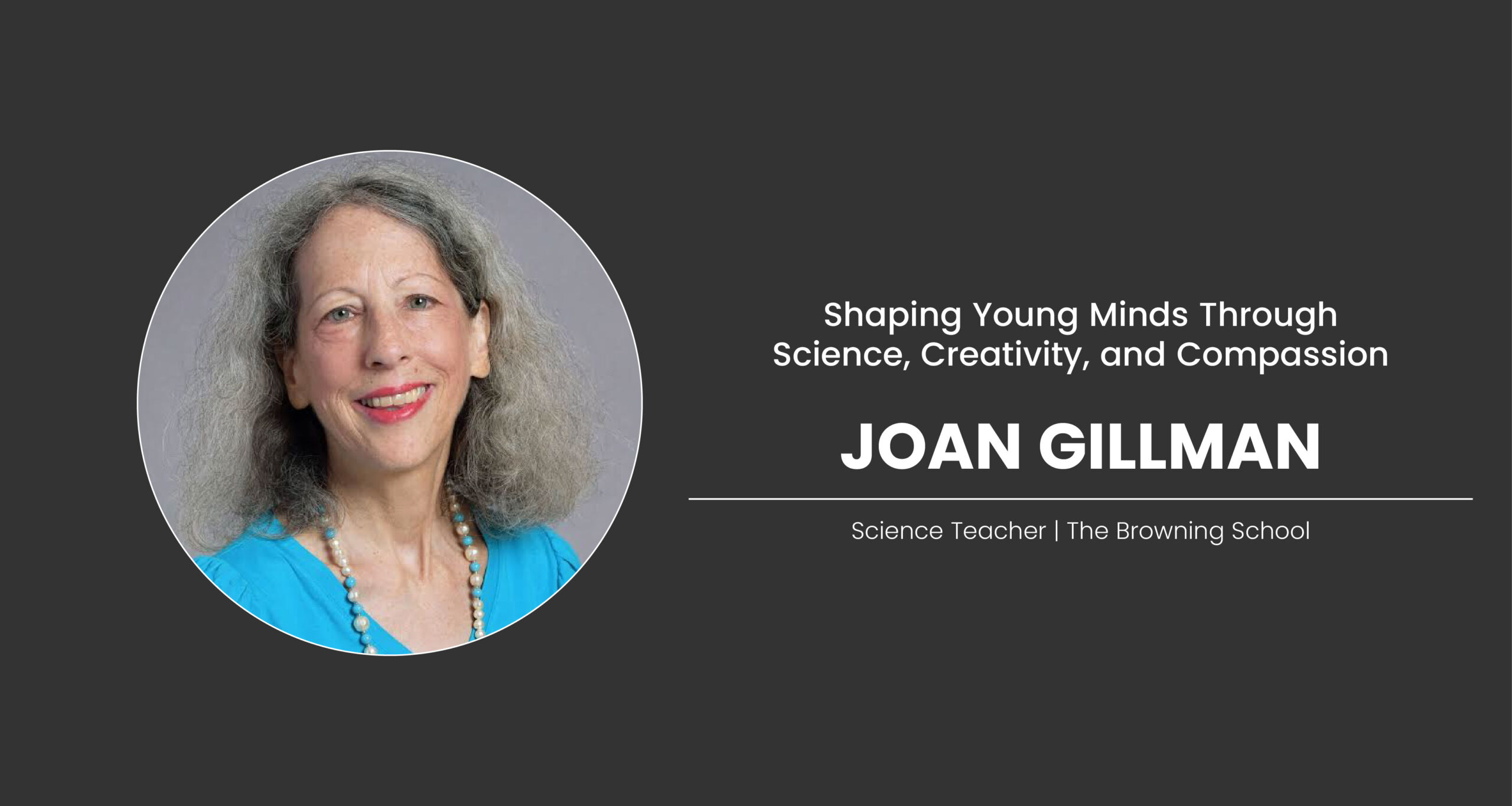
When asked what sparked her passion for teaching, Joan Gillman does not hesitate to trace the roots back to her high school years. Long before she became one of the most respected science educators in New York City, Gillman discovered the transformative power of education by teaching children to play the recorder, tutoring math in small groups, and leading inclusive playground games at her school. She also found joy teaching swimming to children, including those with special needs, and even stepped in as a substitute ballet teacher at a local dance studio. Those early experiences instilled in her a lifelong belief: every child deserves an opportunity to shine, no matter their ability.
It was this commitment to inclusivity paired with her deep curiosity about the natural world that laid the foundation for a career spanning more than four decades. Today, as a beloved science teacher at The Browning School in Manhattan, Gillman continues to bring that philosophy into her classroom, inspiring generations of students to embrace curiosity, creativity, and compassion.
Early Curiosity and Lifelong Passion for Science
Science was a fascination for Gillman long before she stepped into a classroom as an educator. As a child, she experimented with powders and liquids in her bathroom, convinced she would one day discover a new product. Snowstorms became scientific laboratories as she measured accumulation rates with a yardstick and tracked barometric pressure. Alongside her older brother, she built robots from shoeboxes, designed model cities, and constructed elaborate snow tunnels always engineering, always creating.
“I didn’t realize it at the time, but all those projects were helping me develop the same skills I would later pass on to my students,” Gillman recalls. Her natural curiosity, paired with an unwavering love of teaching, became the compass that guided her through her professional journey.
A Philosophy Rooted in Curiosity and Choice
Gillman’s teaching philosophy has evolved with the times, but one principle has remained constant: learning must be hands-on, engaging, and tailored to the child. Since joining The Browning School in 2018, she has taught across multiple grade levels, from second through sixth, and has also taken on advisory roles for middle school students.
Her classrooms are laboratories of curiosity. In fourth grade, students design and launch straw rockets, experimenting with variables like fin shape, nose cone size, and launch angles before redesigning their models based on data. In sixth grade, lessons on natural disasters transform into creative public service campaigns where students can make posters, film PSAs, or even invent board games to teach safety rules.
“I don’t believe in a one-size-fits-all curriculum,” Gillman explains. “By letting students choose the medium that works for them, they not only demonstrate their understanding but also discover their own strengths.”
Her creative flair extends to music as well. To introduce new topics, Gillman often performs original science-themed raps, a tradition her students eagerly anticipate. The approach keeps energy high and reinforces the idea that science is not just to be studied but to be celebrated.
Building Environmental Stewards
Beyond the classroom, Gillman has made environmental education a cornerstone of her work. As a leader of The Browning School’s Green Team, she has guided students in organizing fundraisers, conducting Central Park cleanups, and promoting sustainable habits through weekly “Green Action” signs posted across campus.
The club’s annual Biodiversity Day, featuring guest speakers, workshops, and field trips, has become a highlight of the school year. For Gillman, such initiatives are more than extracurricular they are essential to preparing the next generation to tackle climate change.
“Planet Earth’s survival depends on them,” she emphasizes. “If I can help inspire even a handful of students to become environmental stewards, then I feel I’ve made a meaningful contribution.”
Adapting Through Challenges
Gillman’s resilience as an educator has been tested many times, most notably during the COVID-19 pandemic. When classrooms went virtual, she reimagined her teaching methods to ensure her students remained engaged. She sent lists of household supplies so families could replicate experiments from their kitchens and created interactive demonstrations over video calls. Parents expressed astonishment at her ability to make online science not just tolerable, but exciting.
Years earlier, another defining moment came during the 1986 Challenger disaster. Charged with explaining the tragedy to her sixth-grade class, Gillman realized how deeply teachers shape the emotional and intellectual lives of students. “That day showed me the profound responsibility educators carry,” she reflects.
Harnessing Technology for Engagement
From chalkboards to SmartBoards, Gillman has witnessed the technological evolution of education firsthand. What once seemed intimidating is now indispensable. She seamlessly integrates Chromebooks, interactive boards, and digital platforms like Seesaw, Google Classroom, and Canvas into her lessons, ensuring each age group has tools suited to their needs.
She sees technology as both a blessing and a challenge, noting that artificial intelligence will likely play an increasing role in science education. But her stance is measured: “Technology should enhance learning, not replace the skills students need to develop on their own.”
Mentorship Beyond Academics
Gillman’s influence stretches far beyond textbooks and experiments. Through her advisory role and her leadership with the Green Team, she helps students build empathy, resilience, and a sense of responsibility. A lesson on global water shortages once inspired a sixth grader to spearhead a fundraiser through the club, ultimately raising over $1,000 for water.org.
“These are the moments that show me teaching is about so much more than academics,” she says. “It’s about empowering young people to see themselves as capable of making real change.”
Recognitions and Accomplishments
Over her distinguished career, Gillman has earned numerous accolades. Her curriculum “Straw Rockets are Out of This World” was published by Science and Children in 2013 and later republished in Bringing STEM to the Elementary Classroom. She has contributed to professional texts, including What Teachers Want to Know About Teaching Climate Change, and has been a frequent presenter at national science conferences.
Her work has been recognized by Marquis Who’s Who, which honored her with titles ranging from Top Educator to Lifetime Achievement Award recipient. She was also named the 2017 Urhy Teacher of the Year at the Calhoun School. Most recently, the International Association of Top Professionals selected her as its Top Educator of the Year 2025 an honor she describes as “humbling and exhilarating.”
Beyond accolades, Gillman values the opportunities to connect with peers. “Teaching workshops for fellow educators has been one of the most rewarding parts of my career,” she says.
Looking Ahead
As she looks toward the future, Gillman is focused on helping The Browning School fully implement the Next Generation Science Standards (NGSS) across grades K–8. She also plans to continue leading the Green Team, expanding its initiatives, and sharing her expertise at professional conferences.
She is optimistic about the future of education, envisioning a sector where collaboration, interdisciplinary learning, and environmental consciousness are central. “Learning doesn’t happen in isolation,” she reminds. “Science connects with math, art, literature and ultimately with life.”
Advice to the Next Generation of Educators
For aspiring teachers, Gillman offers three pieces of advice. First, never stop learning Professional development is key to longevity and enthusiasm in teaching. Second, keep a sense of humor. “Some days will test you, but humor will carry you through.” Finally, lean on your colleagues. “You are part of a community of professionals. Do not be afraid to ask for help.”
Teaching, she acknowledges, can be exhausting. But the rewards far outweigh the challenges. “There’s nothing more fulfilling than seeing a child’s face light up when they understand something new.”
A Life Balanced by Music
Outside the classroom, Gillman finds balance through music. A skilled violinist and pianist, she plays in orchestras and continues to hone her craft. Music, she says, provides her with perspective: “When I struggle with a difficult piece, it reminds me of my students wrestling with new concepts. It deepens my empathy.”
Conclusion
For more than 40 years, Joan Gillman has devoted her life to education, weaving together science, creativity, and compassion. Her classrooms are places where rockets fly, disasters become learning opportunities, and environmental advocacy begins with a single idea. Recognized internationally for her contributions, she remains grounded in the simple joy of helping each child discover their potential.
In an era where education faces constant challenges, Gillman’s career is a testament to resilience, innovation, and heart. She embodies what it means to be a true leader in the field, one who does not just teach science but ignites a passion for learning, caring, and
creating a better world.
📌 Visit Joan Gillman👉 – LinkedIn Profile