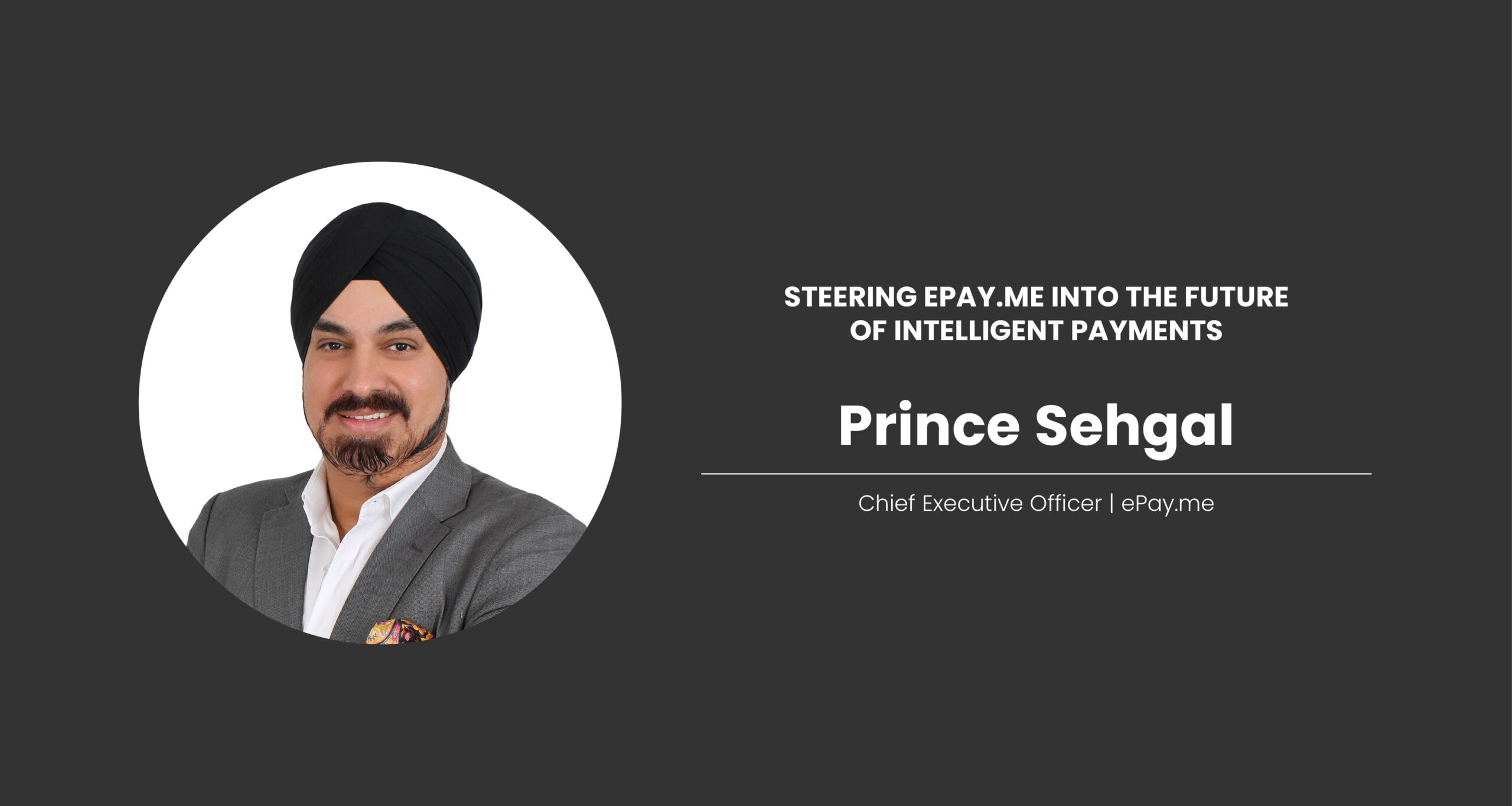
In a region rapidly transforming into one of the world’s most progressive fintech hubs, leadership is no longer defined by traditional business acumen alone. It demands strategic clarity, resilience, and the ability to build systems that are both innovative and deeply reliable. Few leaders embody this blend better than Prince Sehgal, the Chief Executive Officer of ePay.me. His evolution from logistics entrepreneur to fintech visionary reflects a rare mix of operational discipline, market foresight, and a commitment to creating financial technologies that genuinely empower businesses.
Today, as the Middle East intensifies its shift toward digital, cashless, and cross-border commerce, Prince stands at a critical intersection. Under his guidance, ePay.me is expanding across digital payments, alternative payment methods, merchant infrastructure, and its newest frontier a full forex payments and brokerage ecosystem designed for a global trading market. His story illustrates what it takes to lead a next-generation fintech company in one of the world’s fastest-moving regions.
A Journey Built Across Borders and Industries
Prince’s career began not in fintech, but in the demanding world of logistics and international trade. As he scaled companies like AGL Logistics and Swizz Logistics, he mastered operational precision, cross-border coordination, and the discipline required to manage complex workflows. These early experiences became the foundation of his leadership style structured, meticulous, and grounded in problem-solving.
His pivot to financial technology came when he identified a growing market gap. E-commerce was expanding, traders were operating globally, and cross-border business was accelerating yet payment systems in the region remained fragmented and inefficient. Businesses lacked a unified, intelligent platform that could handle high-volume, multi-market transactions with speed and reliability. This realization led to the founding of ePay.me in 2018, built on a simple but powerful vision: to create a fast, transparent, and merchant-centric payment ecosystem tailored to the Middle East and Asia. The years that followed brought several industry-defining milestones as the company matured into a multi-vertical fintech force.
Inside ePay.me: A Platform Engineered for Modern Commerce
Unlike traditional players burdened with legacy systems, ePay.me was built from the ground up using a modular, microservices-based architecture. This technical foundation allows the company to innovate quickly, scale seamlessly, and ensure uninterrupted service a critical requirement for merchants across high-growth sectors.
Its core offerings have evolved into a comprehensive suite of solutions:
- Online payment gateway and merchant acquiring
- Card payments and an extensive set of alternative payment methods
- Multi-currency processing and cross-border settlements
- Smart-routing to optimize approval rates
- Real-time dashboards, analytics, and reporting
But what truly sets ePay.me apart in today’s landscape is its powerful entry into the forex and brokerage payments vertical. This specialized infrastructure supports the fast-growing online trading ecosystem, enabling brokers to manage deposits, withdrawals, and settlements across regions with unmatched speed.
The forex solution includes:
- Instant global trader deposits
- Automated withdrawal flows integrated with local rails
- MT4/MT5/CRM integrations
- Multi-currency wallets and segregated account structures
- APM coverage for international trading markets
- High-frequency risk scoring designed for volatile environments
With this expansion, ePay.me has positioned itself as a critical infrastructure provider in a sector that demands security, compliance, and precision.
Technology and Innovation: The Backbone of Prince’s Strategy
To Prince, innovation is not merely a goal it is the operational core of ePay.me. The company’s technology ecosystem incorporates advanced capabilities such as:
- AI-driven fraud detection using adaptive machine learning
- Cloud-native infrastructure ensuring high availability
- Tokenization and multi-layer encryption for secure handling of sensitive data
- Intelligent smart-routing engines to increase transaction approvals and reduce costs
- Automated onboarding systems that eliminate merchant friction
Leadership Rooted in Empowerment, Clarity & Accountability
Prince’s leadership philosophy centers on three principles: clarity, empowerment, and accountability. He believes teams perform best when given direction but not restricted, responsibility without micromanagement, and the freedom to innovate without fear of failure.
This culture open, ambitious, and built on collaborative thinking has shaped ePay.me’s internal DNA. Employees are encouraged to challenge assumptions, explore new ideas, and maintain a customer-first mindset. Under Prince’s guidance, the company has grown into a motivated, resilient, and forward-looking team that thrives on solving complex problems.
Navigating Challenges in a High-Stakes Industry
Fintech is a sector shaped by trust, regulation, and agility. Prince has faced and overcome several defining challenges on his leadership journey.
In its early years, ePay.me had to establish credibility in a market dominated by long-standing institutions. Instead of rushing growth, Prince focused on:
- Strengthening governance
- Deepening banking relationships
- Prioritizing system stability
- Investing in top-tier talent and technology
The company’s expansion into forex posed another layer of complexity. The trading sector demands mass volumes, strict compliance, and specialized transaction monitoring. Prince navigated this by building dedicated infrastructure, enhancing due diligence frameworks, and aligning with global brokerage standards. Each challenge strengthened the company’s foundation and clarified its strategic direction.
Strategic Alliances Fueling Regional Expansion
Growth at ePay.me has been powered by purposeful collaborations. The company has partnered with acquiring institutions, technology vendors, global networks, and fintech providers to extend its capabilities.
The forex expansion has involved deep collaboration with brokerage CRMs, liquidity providers, and trading ecosystem partners. These alliances allow brokers to offer seamless deposit and withdrawal experiences in multiple regions an area where very few fintechs have been able to succeed. As ePay.me prepares to enter new markets, strategic partnerships will continue to play a central role.
The Future of Financial Services in the Middle East
Prince believes the Middle East is on the cusp of becoming one of the world’s most advanced fintech ecosystems. Over the next five years, he expects significant acceleration in:
- Real-time payments
- Open banking and unified APIs
- Embedded finance for sectors like retail and e-commerce
- Digital wallets and super-app ecosystems
- Tokenized assets and settlements
- AI-driven financial operations
These shifts will fundamentally redefine how money moves across borders, especially in trading and forex. Faster withdrawals, frictionless onboarding, and intuitive cross-border settlements are already in demand and ePay.me is positioned ahead of the curve.
Advice for Aspiring Fintech Entrepreneurs
Prince’s journey reinforces a simple truth: sustainable fintech innovation is built on trust, discipline, and consistency. His advice to young entrepreneurs is clear:
- Build for long-term impact, not short-term hype
- Put compliance at the center of your operations
- Prioritize stability before scale
- Pair ambition with responsibility
For him, success belongs to those who can innovate without compromising integrity.
What’s Next for ePay.me
The company is now entering an ambitious expansion phase. Upcoming initiatives include:
- Launching operations in Saudi Arabia, Bahrain, and Oman
- Expanding crypto-to-fiat payment capabilities
- Enhancing AI-powered merchant analytics
Scaling its forex vertical with:
- Instant global deposits
- Automated withdrawals
- Multi-currency accounts
- Local settlement rails
- Deep CRM and trading platform integrations
- Treasury and liquidity optimization solutions
Prince’s long-term goal is to transform ePay.me into one of the region’s most comprehensive and trusted financial infrastructure providers.
A Legacy of Integrity, Innovation, and Purpose
From logistics warehouses to high-performance fintech infrastructure, his story is a powerful reminder that leadership is built on consistency, clarity, and trust. Today, as ePay.me supports merchants and brokers across continents, Prince remains committed to the mission that began it all to enable growth, empower entrepreneurship, and shape the financial future of the Middle East.
Through purpose-driven leadership and relentless innovation, Prince Sehgal has redefined what it means to build fintech for the next era: intelligent, transparent, and built to empower.
- 📌 Visit Prince Sehgal 👉 – LinkedIn Profile
- 🌐 Explore ePay.me 👉 – Company Website