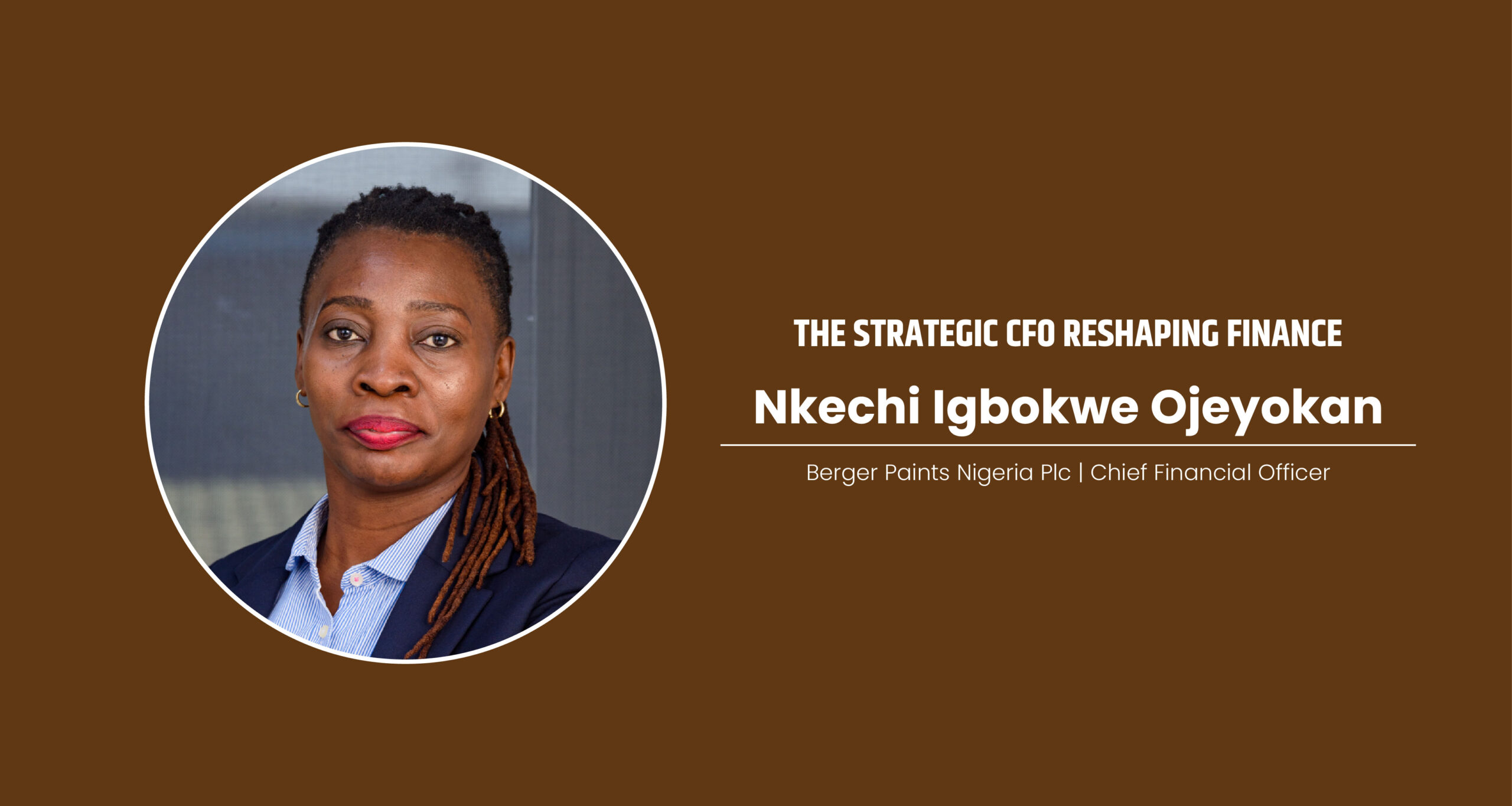
In the fast-moving corridors of Nigerian business, where volatility in markets and unpredictability in policy shifts often test the resilience of companies, one finance leader stands out for her ability to combine discipline with innovation. Nkechi Igbokwe Ojeyokan, the Chief Financial Officer of Berger Paints Nigeria Plc, has built her reputation as one of the most strategic CFOs redefining what financial leadership means in 2025.
Her journey from a young finance graduate in the UK to the executive suite of one of Nigeria’s most respected manufacturing companies is not just a chronicle of steady career progression it is a case study in adaptability, foresight, and the power of finance to influence corporate destiny.
The Making of a Finance Leader
Nkechi’s story begins with a rigorous academic grounding. In 2007, she earned an MSc. in Finance and Investment at the University of Ulster, Coleraine. Like many ambitious young professionals, she cut her teeth in temporary roles in accounts receivables in the UK before returning home to Nigeria. That decision set her on a trajectory that would eventually establish her as one of the country’s leading voices in finance.
In 2009, she joined Nigerian Breweries Plc, a member of the Heineken Group and one of the largest companies in West Africa. Her entry role as a Financial Control Analyst gave her a first real taste of what corporate finance demanded: accuracy, speed, and insight. She handled product variance analysis, functional expense reporting, and deviation commentaries tasks that sharpened her analytical eye and taught her how numbers tell a story far beyond ledgers.
As she rotated through roles including Interim Payment Accountant and Internal Audit Assistant she developed a well-rounded skillset. Vendor payments, ERP migration, audit preparation, and the creation of a key control framework exposed her to a wide spectrum of business operations. These years built the foundation for her ability to see finance not just as an administrative function, but as a lens for understanding the entire business.
Rising Through the Ranks
By 2012, Nkechi was promoted to Business Unit Controller for Lagos, a role that placed her closer to management decision-making. Suddenly, finance was no longer about reporting past performance it was about shaping future outcomes. She partnered with business leaders, embedded controls, and ensured financial integrity aligned with operational goals.
Her upward trajectory continued in 2015 when she was appointed Business Controller for the West Zone. Here, she managed financial operations across seven sales regions in eight states. The scale was staggering: managing credit of ₦9.2 billion to generate revenues exceeding ₦124 billion by 2019.
Under her leadership, Nigerian Breweries achieved remarkable cost discipline and revenue growth. Bad debt levels were maintained at less than 0.05% of revenue. Through rigorous budget monitoring, she delivered savings of 15% against planned spending. Control compliance stood consistently above 90% from 2017 to 2019. But perhaps just as importantly, Nkechi honed her skills as a leader of people mentoring direct reports, driving performance management, and learning how to inspire teams to deliver at scale.
A Defining Chapter at Champion Breweries
If her years at Nigerian Breweries were about honing her craft, her tenure at Champion Breweries Plc was about transformation. In 2020, she was appointed Finance Director of the Heineken-owned company a promotion that came with steep challenges.
The world was in the grip of the COVID-19 pandemic. Nkechi, now a mother of two young children, relocated across Nigeria to assume her new role. Beyond finance, her responsibilities expanded to include Procurement and IT functions she had no prior experience in.
It was a trial by fire. Yet, under her leadership, Champion Breweries thrived. Between 2020 and 2022, revenue surged by 77% and net profit skyrocketed by 841%. She introduced pricing and discount strategies, optimized distribution costs through investments in logistics, and doubled the company’s cash balance.
Governance improvements were equally significant: policies were updated, customer contracts revised, risk registers overhauled, and fixed asset verification completed. A 2 billion loan was secured from the Bank of Industry at a single-digit interest rate, fueling critical projects. Most impressively, she led a team of 13 professionals across Finance, Procurement, and IT, molding them into a cohesive, high-performing unit.
This chapter, Nkechi recalls, was the defining moment of her career. It forced her to expand beyond her comfort zone, to lead with urgency, and to rely on collaboration and resilience. It also deepened her understanding that finance leaders must be business leaders first.
Driving Growth Across Industries
By 2023, Nkechi transitioned to The Big Bottling Company, a member of the AJE Group, as CFO. The challenge this time was market re-entry. She negotiated with vendors to restore supply chains, engaged bankers to reinstate loans, and crafted financial plans to stabilize the business. Managing a cross-functional team spanning Finance, IT, and HR, she ensured the company was positioned for sustainable performance.
Her tenure here reinforced one of her core strengths: navigating volatility with calm, precision, and creativity. Whether through working capital management, stakeholder engagement, or vendor relationship rebuilding, Nkechi demonstrated that the CFO role extends well beyond numbers.
The Berger Paints Era
In 2024, Nkechi accepted the role of CFO at Berger Paints Nigeria Plc, a company with a legacy as vibrant as its products. Berger Paints, listed on the Nigerian Exchange, is a pioneer in paint and allied manufacturing. For Nkechi, the role represents both a culmination of her career and a new frontier.
The results under her leadership have been transformative. Revenue grew by 36% in 2024 compared to 2023, while profit after tax climbed 31%. Gross profit margins improved by 10%. She reduced financial reporting timelines from ten working days to three, introduced weekly and monthly dashboards, and optimized working capital through inventory management.
Leading a team of seven finance professionals, she has fostered a culture of accountability and performance. At Berger Paints, she is not just a steward of the balance sheet she is a strategist driving growth, profitability, and long-term sustainability.
Redefining the CFO Role in 2025
The modern CFO is no longer a back-office guardian of books. In 2025, the role is defined by strategy, risk management, regulatory compliance, and technological adaptation. Nkechi embodies this evolution.
She engages actively with functional heads to highlight performance gaps and drive timely corrective actions. She keeps herself informed through professional memberships and industry networks, ensuring her knowledge of compliance, governance, and technological trends remains current. Just as crucially, she prioritizes people development, mentoring her team to achieve both organizational and personal career goals.
For her, the CFO role is about partnership with the CEO, with the board, and with every function of the business. Finance is the anchor, but strategy is the sail.
Principles and Resilience
At the heart of Nkechi’s leadership are two core principles: quality and business knowledge. Accuracy in financial data, she insists, is the bedrock of good decision-making. Equally, an intimate knowledge of the business allows finance professionals to spot anomalies, understand cost drivers, and make recommendations that truly matter.
Her resilience is rooted in perspective. She reminds herself that she is never alone many professionals face similar pressures. By staying organized, prioritizing key tasks, and keeping communication channels open, she maintains focus even in high-pressure situations.
Mentorship and Giving Back
Nkechi’s success has been shaped by mentors, particularly during her time at Nigerian Breweries. A structured mentorship program provided her with clarity, guidance, and a roadmap for career progression. Today, she pays that forward. She mentors young professionals, encourages them to define career paths, and challenges them to develop the skills and focus required for leadership.
For her, mentorship is not just about giving advice it is about opening doors, sharing experiences, and instilling confidence in future finance leaders.
Lessons from Risk and Volatility
The 2023-naira devaluation and rising inflation rates posed one of the toughest financial risks of her career. With raw material and energy costs soaring while consumer purchasing power declined, pricing strategies alone were insufficient. Instead, she championed alternatives: sourcing substitute materials, adjusting production schedules, and introducing new products.
The episode reinforced a critical lesson: agility is non-negotiable. In today’s business environment, leaders must always prepare alternatives to pivot swiftly when circumstances change.
Advice for Tomorrow’s CFOs
For finance professionals aspiring to become strategic CFOs, Nkechi offers five guiding principles:
Know the business—finance leaders must understand their industries beyond the numbers.
Build strong teams—engaged, motivated people deliver sustainable results.
Network and learn—stay connected with peers, associations, and industry trends.
Be a true partner—work with functional heads, hold yourself accountable, and uphold the highest standards.
Think long-term—build strategies that deliver on both immediate and future company goals.
The Legacy of a Strategic CFO
In the world of finance, few roles are as pivotal as the CFO’s. Yet few leaders manage to transform the role into a lever for organizational growth, resilience, and innovation. Nkechi Igbokwe Ojeyokan has done just that.
Her career is a blueprint for the future of financial leadership rooted in strong technical expertise, expanded through strategic thinking, and elevated by people-centered leadership. At Berger Paints Nigeria Plc, she is proving that the CFO of the future is not just a numbers custodian but a strategist, mentor, and visionary.
As 2025 unfolds, Nkechi stands as a symbol of what finance can achieve when it is bold, forward-looking, and deeply attuned to the business it serves. She is, without question, one of the most strategic CFOs reshaping the role of finance in Nigeria and beyond.
- 📌 Visit Nkechi Igbokwe Ojeyokan👉 – LinkedIn Profile
- 🌐 Explore Berger Paints Nigeria Plc 👉 – Company Website