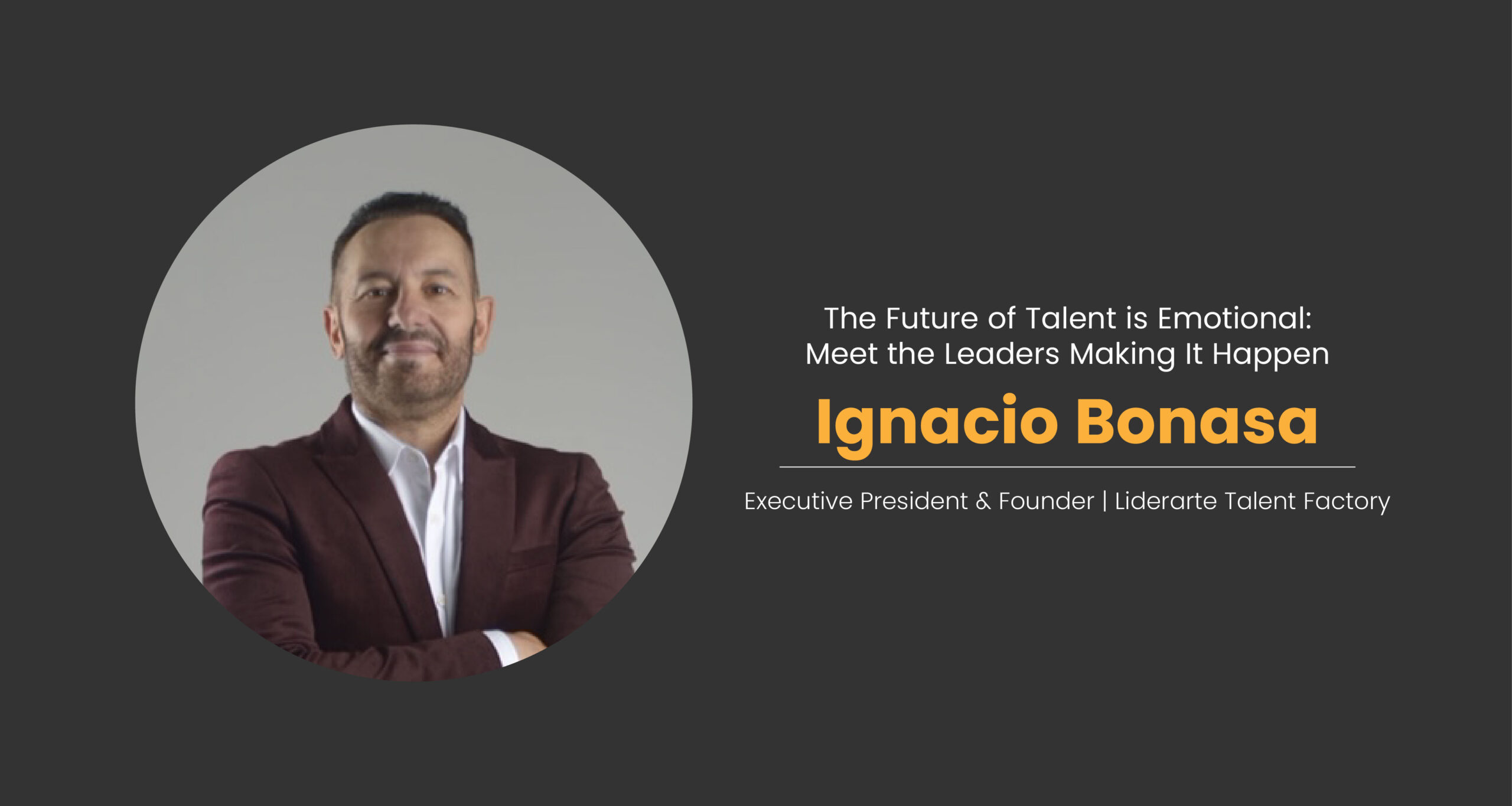
Ignacio Bonasa: The Human Touch Behind Leadership

In a world obsessed with technology, metrics, and performance, Ignacio Bonasa has chosen a different path — one that speaks not to machines, but to hearts.

As President and Founder of LIDERARTE, Bonasa has built much more than an organization; he has built a movement of soulful leadership.

LIDERARTE is not a business school nor a consulting firm. It is a factory of human transformation, where leadership and art merge to form something profoundly different: leaders with soul.

Under Bonasa’s visionary guidance, the classroom becomes a stage, art becomes a teacher, and every experience turns into a mirror for self-discovery.

His pioneering approach, Learning Through Art, structured under the 4A Model, has reached leaders, educators, and organizations across Europe and Latin America — awakening them to a deeper question: What does it truly mean to lead as a human being?

Today, Ignacio Bonasa stands as a bridge between art and leadership, heart and intellect, emotion and action — showing the world that true leadership begins not with power, but with purpose.

A Vision Born from Emptiness

Before founding LIDERARTE, Bonasa had already achieved what most professionals dream of: success, stability, and recognition in the corporate and banking sectors. Yet beneath the surface of achievement, he felt a deep void.

“Success without meaning,” he reflects, “is emptiness in disguise.”

That realization became the turning point of his life. Bonasa decided to create a space where people could reconnect with their essence — a place where leadership was not just about management, but about humanity.

That vision gave birth to LIDERARTE, a sanctuary for rediscovering purpose through creativity, empathy, and self-awareness.

LIDERARTE: Where Leadership Meets Art

When asked to define LIDERARTE in one sentence, Bonasa smiles and says:

“It’s where leadership meets art — and the human being becomes the masterpiece.”

This poetic definition captures the essence of his philosophy. Unlike conventional leadership programs that rely on theories and frameworks, LIDERARTE offers transformative experiences.

Through music, painting, theatre, and nature, participants are invited to see themselves in a new light — to feel before they think.

“Art awakens what logic silences,” Bonasa explains. “It touches emotions, activates creativity, and invites reflection. Only when people feel can they truly transform.”

In LIDERARTE’s workshops, the boundaries between artist and leader disappear. The stage becomes a classroom, the paintbrush a tool of expression, and every exercise a metaphor for life.

“Leadership is an art — and every leader is a work in progress.”

The 4A Model: A Formula for Human Transformation

At the heart of LIDERARTE lies the 4A Model, Bonasa’s original framework for leadership development:

  • Learning must be experiential, grounded in real emotion.
  • Attitude must remain positive and constructive, even in uncertainty.
  • Soul must stay connected to one’s essence and authenticity.
  • Action must translate insight into tangible, positive impact.

This model guides individuals and organizations through a transformative journey — from knowledge to consciousness. Bonasa describes it as “a compass for evolution: from management to leadership, from performance to purpose.”

Art as Teacher, Emotion as Guide

What makes Bonasa’s approach so unique is his belief that art is the most powerful teacher of all. Whether through painting, theatre, dance, or music, art becomes a mirror reflecting the invisible — our fears, dreams, and untapped potential.

“Art helps people reconnect with their creative side,” he says. “And when they do, they become more human. They lead with empathy, listen with presence, and inspire through authenticity. Creativity is not a skill — it is a state of consciousness.”

Through programs like Naturalizarte, LIDERARTE takes participants beyond the boardroom and into nature. Here, trees replace walls, and silence becomes the most eloquent teacher.

“When people reconnect with nature,” Bonasa adds, “they reconnect with themselves.”

Impacting Organizations Through Humanity

LIDERARTE’s impact on organizations is both profound and practical. Bonasa’s team helps companies create cultures of trust, purpose, and vitality — what he calls Vitamin Organizations.

“These are organizations that energize rather than drain,” he explains. “They generate positive energy — vitamins for the soul — through trust, collaboration, and wellbeing.”

By focusing on emotional intelligence and purpose-driven culture, LIDERARTE turns teams into orchestras, where every individual plays their part in harmony.

“Our methodology transforms how people communicate, collaborate, and connect,” Bonasa says. “We measure transformation not only by performance, but by emotion — by the light in people’s eyes when they rediscover meaning.”

A Community, Not a Company

Bonasa often says, “LIDERARTE is not a company — it’s a community.” And he means it.

The organization is built as a collective of dreamers, creators, and changemakers, each contributing their unique essence to a shared vision.

“We select our collaborators not by résumé, but by essence,” Bonasa explains. “We look for people who are alive inside — with passion, integrity, and purpose. Only those who lead with soul can help others find theirs.”

This sense of community gives LIDERARTE its heartbeat. Every facilitator, artist, and leader who joins the movement adds a new brushstroke to its living canvas.

Redefining Leadership for the Future

In Bonasa’s world, the future of leadership is not digital — it’s human. He firmly believes that the next great revolution won’t come from artificial intelligence, but from authentic intelligence: empathy, resilience, creativity, and compassion.

“Human Skills,” he says, “are the new core competencies. Technology without humanity is just noise.”

Bonasa dreams of forming leaders who elevate rather than dominate — individuals who know themselves, manage their emotions, and contribute meaningfully to society. These are leaders who understand that success is not about control, but about connection.

A Dream Without Borders

When asked about his dream for LIDERARTE’s future, Bonasa’s eyes light up:

“I dream of a world where every organization has its own LIDERARTE inside — a world where art, purpose, and humanity redefine what it means to lead.”

Already, his message has traveled far beyond Spain and Latin America, touching lives across continents. Each workshop, each talk, each experience becomes a ripple in a global tide of conscious leadership.

For Bonasa, transformation is not a one-time event; it’s an ongoing journey — a constant dance between learning and becoming.

Emotional Closing

Ignacio Bonasa does not teach leadership — he paints it, sings it, and lives it.

He turns the corporate world into a canvas and reminds us that leadership is not about titles, but about transformation.

Because, as he often says:

“When a leader leads with soul, the organization breathes;

when an organization breathes, society heals.”

Turn it around. Reset yourself. Lead with soul.

Because change begins within you.

Oscar van Antwerpen: Leading Africa’s Mining Future with Integrity, Innovation, and Impact

In the world of mining and natural resources, where geology meets engineering and strategy intertwines with sustainability, Oscar van Antwerpen has been functioning and interweaving these disciplines to carve a distinctive path. His journey is not merely about extracting value from the Earth, but about unlocking potential of people and processes, and the planet itself. From his early fascination with geological formations to his leadership in reshaping Africa’s mining narrative, van Antwerpen’s career reflects a blend of scientific curiosity, ethical conviction, and visionary leadership.

A Curiosity Born from the Earth

For Oscar, the fascination with the natural world began long before he entered the mining industry. As a child, he was fascinated by the patterns of rocks exposed in road cuttings, the layers of mountain formations, and the stories told by fossils. Initially drawn to botany and zoology, his academic curiosity took a new direction when he stumbled upon the geology department’s mineral collection. That moment, as he describes it, was transformative: “It completely shifted my perspective.”

The mineral collection portrayed the beauty of Earth’s processes, the chemical precision, the geological mystery, and the tangible link between science and the real world. Geology became a tool to understanding not just how the Earth worked, but how humans could interact with it responsibly. That fascination developed into a lifelong interests and study combining natural science with the practical applications of engineering. Mining, for him, became the ultimate field where those worlds met.

Standing 3,000 metres below the Earth’s surface for the first time, surrounded by the product of millions of years of geological transformationan orebody —van Antwerpen recalls being filled by amazement. “It was a showpiece  of engineering,” he says. “Mining gave me the opportunity to solve complex challenges across different disciplines, every project a new problem to understand, every orebody a new set of rules to understand.”

A Leadership Vision Rooted in Empathy and Excellence

Van Antwerpen’s leadership philosophy is grounded in a simple belief: people thrive when they feel valued, acknowledged, and empowered, and participating in a project and or company with direction.   “Great leadership,” he says, “starts with recognising the value of diverse talent—intellectual, emotional, and creative.”

Oscar leads with empathy, creating environments where his teams feel supported to grow, contribute meaningfully, and pursue their personal goals. His approach is far from traditional; it combines technical excellence with emotional intelligence. Under his guidance, teams are encouraged not only to meet operational targets delivering projects safely, sustainably, on time, and within budget but also to innovate, challenge conventions, and think differently.

Van Antwerpen’s mission is clear: to lead by example, build shared purpose, and deliver sustainable impact. It is a style of leadership that has inspired loyalty, driving performance across the mining sector. 

Navigating Challenges with Integrity

The mining sector in Africa, despite its vast potential, faces numerous challenges from corruption, starvation, famine, war to mineral tenement problems, logistical constrains, skill shortages and electricity shortages. For van Antwerpen corruption stands as one of the greatest barriers to progress. “Corruption doesn’t just slow things down,” he notes. “It undermines development, diverts funds, and damages trust.” It also undermines investor interest.

Encouragingly, Antwerpen sees positive change. “In countries where corruption is being tackled head-on, progress is tangible. Ethical leadership is not optional.  It is the key to transforming resource wealth into sustainable development.” His conviction that integrity is the foundation for long-term growth has become a cornerstone of his leadership legacy.

Redefining Mining through Geometallurgy

Among van Antwerpen’s most transformative achievements is his application of geometallurgy, an approach that integrates geological and metallurgical insights to optimise mining operations. Traditionally seen as a technical specialty, geometallurgy has become a central tool in day-to-day operations, revolutionising resource extraction and recovery.

The results have shown that projects once deemed non-viable are now profitable, resources previously out of reach are being successfully mined, and efficiency has improved across multiple sites. The use of this technique has helped many marginalised ore deposits to be mined profitably.  .

Sustainability at the Core

Van Antwerpen’s approach to mine planning and resource optimisation is  intertwined with sustainability and community empowerment. “Sustainability isn’t an add-on.  It’s built into how we operate from day one,” he emphasises. His focus extends beyond compliance to real, lasting impact.

Oscar, also champions geometrical modelling, integrating geological and metallurgical data to refine mine plans and optimize production. The result? Lower capital costs, higher project value, and improved IRR and NPV. “Innovation isn’t about replacing people,” he explains, “it’s about empowering them to work smarter, safer, and more effectively.”

Oscar strongly advocates for in-country beneficiation, ensuring that raw materials are processed locally to stimulate job creation and strengthen local economies. “It’s about keeping value where it’s needed most,” he says. Environmental rehabilitation is another priority. From land restoration to preventing acid mine drainage, his teams work diligently to ensure these considerations are integrated to the planning process.  .

On the human side, van Antwerpen’s philosophy is clear: communities must grow alongside the mines. His organisations invest in structured training, career development, and the integration of local talent into core operations. “We want to build something that lasts,” he adds. “That’s the true spirit of sustainable development.”

Harnessing Innovation and Technology

Technology, for van Antwerpen, is more than a tool: it’s a mindset. His company has been developing in-house tools to leverage AI and deep learning in geological exploration and modelling, enhancing the process of target selection.  These systems have dramatically improved the detection of geological anomalies as the datasets currently being generated are fast and complex. 

Empowering Local Talent and Building Capacity

Central to van Antwerpen’s leadership is a deep commitment to local empowerment. He prioritises hiring and training local geologists and engineers, fostering skills transfer and capacity building across the continent. “We invest in education and training because that’s what makes development sustainable,” he says.

Through partnerships with universities and graduate programs, his teams are nurturing the next generation of mining professionals. It is a long-term strategy designed not only to grow talent but also to anchor expertise within Africa. “We’re building the future workforce of the industry,” he notes.

Africa’s Place in the Global Mining Economy

Africa, van Antwerpen believes, stands on the brink of a major transformation. With vast reserves of critical minerals— from copper and iron ore to rare earths—the continent has all the ingredients for a thriving mining economy. But, as he points out, “having resources isn’t enough.”

Oscar’s focus has been on promoting internal processing, strategic planning, and transparency to ensure that Africa captures more of the value chain. He also places strong emphasis on education, empowering leaders and decision-makers to understand the transformative power of geometallurgy—and to ensure resource rent is put to proper use.

“It’s a mindset shift,” he says. “Africa is not just a source of raw materials. It is a global player with the expertise, technology, and leadership to shape its own destiny, and should be developed as such.”

Looking Ahead: A Smarter, More Sustainable Future

In the short term, van Antwerpen’s goals are focused on expanding the implementation of geometallurgy and improving resource extractability. In the long run, he envisions an African mining industry that is self-sufficient, technologically advanced, and globally competitive.

That vision includes stronger local beneficiation, deeper environmental stewardship, and genuine community engagement. “Success,” he says, “isn’t just measured in tonnes mined or profits made. It’s measured in the value we create for people, for the environment, and for the future.”

A Legacy of Empathy, Integrity, and Empowerment

Asked what advice he would give to aspiring leaders, van Antwerpen does not hesitate. “Leadership starts with empathy, integrity, and purpose. Education, transparency, and strategy must sit at the centre of everything we do.”

Oscar urges young leaders to tackle corruption, to innovate fearlessly, and to build organisations that uplift rather than exploit. “Real change doesn’t happen by accident; it happens when leaders act with integrity and vision.”

Among his proudest initiatives is the “Be The Good” foundation,  his non-profit dedicated to supporting vulnerable communities through early childhood development and poverty relief programs. It reflects the same principles that guide his professional life: empathy, education, and empowerment.

And perhaps that is the essence of Oscar van Antwerpen’s story: a leader who looks beneath the surface not just to extract value, but to uncover meaning; who sees mining not as an end, but as a platform for progress. His legacy is not only in the resources unearthed from the ground, but in the opportunities and hope he helps cultivate above it.    

Bob Friday: The Architect of the Self-Driving Network

In the dynamic world of technology, where innovation moves at the speed of light and transformation is the only constant, few leaders have consistently stayed ahead of the curve. Bob Friday, Chief AI Officer at HPE Juniper Networking, is one of them. His career reads like a blueprint for the evolution of modern networking from the early days of wireless mesh systems to today’s AI-driven, self-healing networks. But beyond his technical brilliance, it is his vision to make mobile access to the internet as ubiquitous and reliable as clean water and power that continues to guide his journey.

From the Dawn of Wireless to the Age of Intelligence

Bob’s career began at the intersection of policy and possibility. The unlicensed spectrum rules created by the FCC in the 1980s opened the door for wireless innovation, a door he was determined to walk through. His first major role at Metricom saw him helping build the Ricochet network, one of the earliest large-scale wireless mesh systems in the United States. “It was about connecting laptops to the emerging internet,” he recalls. “That’s when I realized connectivity would soon become as essential as any utility.”

From Metricom, Bob went on to co-found Airespace, a company that revolutionized how enterprises managed Wi-Fi networks as the workplace became increasingly mobile. When Cisco acquired Airespace in 2005, Bob took on a new challenge leading their enterprise mobility strategy as CTO. His work there pushed forward key industry standards like Hotspot 2.0 and Passpoint, while his team developed innovative wireless location experiences that redefined how users connected and navigated digital environments.

But it was during Cisco’s due diligence on the Meraki acquisition in 2012 that Bob, glimpsed the future of cloud-managed networking. Around the same time, IBM’s Watson famously defeated Jeopardy champion Ken Jennings, signalling that AI had moved from the lab into the real world.

Founding Mist: The Birth of the Self-Driving Network

In 2014, Bob co-founded Mist Systems with a bold vision: to bring real-time, AI-powered automation to enterprise networking. Mist introduced the world to “Marvis,” an AI-driven assistant designed to help IT teams manage networks proactively rather than reactively. It was not just about fixing connectivity issues faster it was about predicting and preventing them before users even noticed.

“The shift,” Bob explains, “was from managing network elements to managing the client-to-cloud user experience. That required a real-time, cloud-based AIOps architecture and a clean slate approach.”

Leading with Vision and Heart

For Bob, leadership has always been a team sport. His startup roots taught him that building a business is not the same as building a product. “You need great customers, great teams across every function, and a shared sense of purpose,” he says. His leadership philosophy blends visionary thinking with practical execution grounded in customer outcomes and driven by empathy for users.

That empathy has been crucial to his focus on artificial intelligence. The turning point came when a large retail customer told him bluntly that they would not deploy his solution until he could ensure faster updates, eliminate crashes, and guarantee a great user experience. “That was when I realized AI wasn’t optional,” Bob says. “We needed real-time cloud AIOps to deliver what customers expected.”

The Chief AI Officer’s Mandate

Today, as Chief AI Officer of HPE Networking, Bob’s role sits at the intersection of technology and transformation. His mandate is clear: guide the expansion of HPE Networking’s Marvis AIOps platform across the enterprise portfolio to deliver an unparalleled client-to-cloud experience. That means setting the long-term AI vision, aligning technology roadmaps with market needs, and driving collaboration between engineering, data science, and product teams.

Balancing strategy and innovation, he says, requires connecting horizon-two research with horizon-one execution. “Innovation can come from anywhere,” he notes. “My job is to water it when I see it.”

AI as the Core of the HPE Juniper Mission

Under Bob’s direction, AI is not an add-on, it’s the foundation of HPE Networking’s self-driving networking journey. By embedding AI into every layer of the network, HPE Networking is moving from reactive problem-solving to predictive, autonomous operations.

Key innovations like the Marvis Conversational Interface, Marvis Actions, Marvis Large Experience Model (LEM), and Marvis Minis exemplify this evolution. These agentic-based tools help predict and resolve issues before they affect users, automate repetitive IT tasks, and continuously learn to improve performance.

AI in Action: Transforming Support and Operations

One of Bob’s proudest initiatives has been integrating Marvis AI directly into HPE Networking’s customer support operations. Traditionally, support teams worked in silos, responding to tickets after problems arose. With a cloud AIOps architecture, support is now built into the product itself.

Ethical AI, by Design

Bob is also a vocal advocate for responsible AI. Under his leadership, HPE Networking has adopted a set of AI Innovation Principles emphasizing transparency, explainability, inclusivity, and data security. “AI should be intentional,” he insists. “It should inform human decision-making, not manipulate human experience.”

The Future: Agentic AI, Trust, and Scale

Looking ahead, Bob identifies three trends that will define AI in 2025 and beyond. Agentic AI, he says, represents a new paradigm, one that allows automation of complex, nonlinear tasks traditionally requiring human reasoning.

Trust, meanwhile, is becoming the new currency. Just as users now trust autonomous vehicles to drive them safely, IT teams will increasingly trust AI systems like Marvis Actions to make and execute operational decisions.

AI and the Next Frontier of Networking

Bob envisions AI transforming networking in three key dimensions: security, automation, and customer experience. The same data used to optimize user experience can now predict cyber risks in real time. Automation will continue to eliminate manual tasks, making networks truly self-driving. And customer experience, once measured in uptime and speed, will evolve into something richer: networks that anticipate needs, adapt dynamically, and make technology feel invisible.

Building Teams for the Future

At the heart of Bob’s leadership is a belief that innovation starts with people. He fosters teams that prioritize customer problems over technical novelty, encouraging curiosity and collaboration across disciplines. “AI is not just math and models,” he says. “It’s about automating cognitive tasks and that takes diversity of thought and trust.”

He also cultivates a culture of continuous learning, encouraging engineers to explore, experiment, and connect their insights back to customer outcomes. “Adaptability comes from empowering people to take risks,” he notes. “Setbacks are part of progress.”

The Road Ahead

Bob’s long-term vision for AI at HPE Networking is clear: deliver on the promise of the Self-Driving Network, a system intelligent enough to predict, adapt, and improve continuously. Through the integration of generative AI, agentic automation, and integration with HPE GreenLake Intelligence, Marvis is evolving from a virtual assistant into a true AI copilot for IT teams.

“The goal,” Bob says, “is to take complexity off operators’ shoulders, reduce costs, and give enterprises a network that just works.”

Words to the Next Generation of AI Leaders

Bob’s advice to aspiring AI leaders is both humble and profound: stay grounded in customer problems. “The real impact of AI isn’t in the model,” he says, “it’s in solving challenges that matter.” He encourages curiosity, resilience, and collaboration, reminding future innovators that AI is ultimately a team effort.

“If you can combine technical vision with empathy for users and a commitment to responsible innovation,” he concludes, “you’ll do more than build great products, you’ll build technology that truly makes life better.

The Data Revolution in HR: How Analytics Shapes the Future of Talent Management

In today’s data-driven business landscape, the world of human resources is experiencing a significant shift. Gone are the days when decisions were primarily based on gut feelings and past experiences. Now, talent analytics is taking the lead, using data to inform smarter, quicker, and more strategic HR choices. From hiring to employee retention, analytics is changing the game for how organizations attract, manage, and nurture their talent.

Modern HR leaders have a treasure trove of workforce data at their fingertips, ranging from employee performance metrics and engagement surveys to learning outcomes and turnover rates. By diving into this data with analytics, they can reveal patterns and insights that were once hidden from view. For example, predictive analytics can help pinpoint which employees might be considering leaving or which candidates are most likely to thrive in certain roles. This empowers HR teams to take proactive steps, reducing costly turnover and enhancing the overall quality of their hires.

Talent analytics is transforming the way organizations approach workforce planning. By leveraging data, companies can predict future skill gaps and tailor their recruitment and training efforts accordingly. Rather than simply reacting to talent shortages, they can proactively anticipate them. This kind of strategic insight not only enhances productivity but also fortifies organizational resilience in an ever-evolving business environment.

Analytics plays a crucial role in promoting diversity and inclusion by offering clear insights into hiring practices, promotion patterns, and pay equity. When organizations embrace data transparency, they can uncover unconscious biases and work towards creating fairer, more inclusive workplaces.

While embracing talent analytics can be a game-changer, it does come with its own set of hurdles. It is essential to ensure that the data is accurate, seamlessly integrate various HR systems, and prioritize employee privacy. Additionally, companies need to focus on upskilling their HR teams so they can effectively interpret and leverage data insights.

The transition from simply handling data to making informed decisions represents a significant shift in HR strategy. By integrating analytics throughout the entire employee lifecycle, companies are evolving HR from a basic administrative role into a dynamic strategic force that fosters growth, boosts engagement, and sparks innovation.

Joan Gillman: Shaping Young Minds Through Science, Creativity, and Compassion

When asked what sparked her passion for teaching, Joan Gillman does not hesitate to trace the roots back to her high school years. Long before she became one of the most respected science educators in New York City, Gillman discovered the transformative power of education by teaching children to play the recorder, tutoring math in small groups, and leading inclusive playground games at her school. She also found joy teaching swimming to children, including those with special needs, and even stepped in as a substitute ballet teacher at a local dance studio. Those early experiences instilled in her a lifelong belief: every child deserves an opportunity to shine, no matter their ability.

It was this commitment to inclusivity paired with her deep curiosity about the natural world that laid the foundation for a career spanning more than four decades. Today, as a beloved science teacher at The Browning School in Manhattan, Gillman continues to bring that philosophy into her classroom, inspiring generations of students to embrace curiosity, creativity, and compassion.

Early Curiosity and Lifelong Passion for Science

Science was a fascination for Gillman long before she stepped into a classroom as an educator. As a child, she experimented with powders and liquids in her bathroom, convinced she would one day discover a new product. Snowstorms became scientific laboratories as she measured accumulation rates with a yardstick and tracked barometric pressure. Alongside her older brother, she built robots from shoeboxes, designed model cities, and constructed elaborate snow tunnels always engineering, always creating.

“I didn’t realize it at the time, but all those projects were helping me develop the same skills I would later pass on to my students,” Gillman recalls. Her natural curiosity, paired with an unwavering love of teaching, became the compass that guided her through her professional journey.

A Philosophy Rooted in Curiosity and Choice

Gillman’s teaching philosophy has evolved with the times, but one principle has remained constant: learning must be hands-on, engaging, and tailored to the child. Since joining The Browning School in 2018, she has taught across multiple grade levels, from second through sixth, and has also taken on advisory roles for middle school students.

Her classrooms are laboratories of curiosity. In fourth grade, students design and launch straw rockets, experimenting with variables like fin shape, nose cone size, and launch angles before redesigning their models based on data. In sixth grade, lessons on natural disasters transform into creative public service campaigns where students can make posters, film PSAs, or even invent board games to teach safety rules.

“I don’t believe in a one-size-fits-all curriculum,” Gillman explains. “By letting students choose the medium that works for them, they not only demonstrate their understanding but also discover their own strengths.”

Her creative flair extends to music as well. To introduce new topics, Gillman often performs original science-themed raps, a tradition her students eagerly anticipate. The approach keeps energy high and reinforces the idea that science is not just to be studied but to be celebrated.

Building Environmental Stewards

Beyond the classroom, Gillman has made environmental education a cornerstone of her work. As a leader of The Browning School’s Green Team, she has guided students in organizing fundraisers, conducting Central Park cleanups, and promoting sustainable habits through weekly “Green Action” signs posted across campus.

The club’s annual Biodiversity Day, featuring guest speakers, workshops, and field trips, has become a highlight of the school year. For Gillman, such initiatives are more than extracurricular they are essential to preparing the next generation to tackle climate change.

“Planet Earth’s survival depends on them,” she emphasizes. “If I can help inspire even a handful of students to become environmental stewards, then I feel I’ve made a meaningful contribution.”

Adapting Through Challenges

Gillman’s resilience as an educator has been tested many times, most notably during the COVID-19 pandemic. When classrooms went virtual, she reimagined her teaching methods to ensure her students remained engaged. She sent lists of household supplies so families could replicate experiments from their kitchens and created interactive demonstrations over video calls. Parents expressed astonishment at her ability to make online science not just tolerable, but exciting.

Years earlier, another defining moment came during the 1986 Challenger disaster. Charged with explaining the tragedy to her sixth-grade class, Gillman realized how deeply teachers shape the emotional and intellectual lives of students. “That day showed me the profound responsibility educators carry,” she reflects.

Harnessing Technology for Engagement

From chalkboards to SmartBoards, Gillman has witnessed the technological evolution of education firsthand. What once seemed intimidating is now indispensable. She seamlessly integrates Chromebooks, interactive boards, and digital platforms like Seesaw, Google Classroom, and Canvas into her lessons, ensuring each age group has tools suited to their needs.

She sees technology as both a blessing and a challenge, noting that artificial intelligence will likely play an increasing role in science education. But her stance is measured: “Technology should enhance learning, not replace the skills students need to develop on their own.”

Mentorship Beyond Academics

Gillman’s influence stretches far beyond textbooks and experiments. Through her advisory role and her leadership with the Green Team, she helps students build empathy, resilience, and a sense of responsibility. A lesson on global water shortages once inspired a sixth grader to spearhead a fundraiser through the club, ultimately raising over $1,000 for water.org.

“These are the moments that show me teaching is about so much more than academics,” she says. “It’s about empowering young people to see themselves as capable of making real change.”

Recognitions and Accomplishments

Over her distinguished career, Gillman has earned numerous accolades. Her curriculum “Straw Rockets are Out of This World” was published by Science and Children in 2013 and later republished in Bringing STEM to the Elementary Classroom. She has contributed to professional texts, including What Teachers Want to Know About Teaching Climate Change, and has been a frequent presenter at national science conferences.

Her work has been recognized by Marquis Who’s Who, which honored her with titles ranging from Top Educator to Lifetime Achievement Award recipient. She was also named the 2017 Urhy Teacher of the Year at the Calhoun School. Most recently, the International Association of Top Professionals selected her as its Top Educator of the Year 2025 an honor she describes as “humbling and exhilarating.”

Beyond accolades, Gillman values the opportunities to connect with peers. “Teaching workshops for fellow educators has been one of the most rewarding parts of my career,” she says.

Looking Ahead

As she looks toward the future, Gillman is focused on helping The Browning School fully implement the Next Generation Science Standards (NGSS) across grades K–8. She also plans to continue leading the Green Team, expanding its initiatives, and sharing her expertise at professional conferences.

She is optimistic about the future of education, envisioning a sector where collaboration, interdisciplinary learning, and environmental consciousness are central. “Learning doesn’t happen in isolation,” she reminds. “Science connects with math, art, literature and ultimately with life.”

Advice to the Next Generation of Educators

For aspiring teachers, Gillman offers three pieces of advice. First, never stop learning Professional development is key to longevity and enthusiasm in teaching. Second, keep a sense of humor. “Some days will test you, but humor will carry you through.” Finally, lean on your colleagues. “You are part of a community of professionals. Do not be afraid to ask for help.”

Teaching, she acknowledges, can be exhausting. But the rewards far outweigh the challenges. “There’s nothing more fulfilling than seeing a child’s face light up when they understand something new.”

A Life Balanced by Music

Outside the classroom, Gillman finds balance through music. A skilled violinist and pianist, she plays in orchestras and continues to hone her craft. Music, she says, provides her with perspective: “When I struggle with a difficult piece, it reminds me of my students wrestling with new concepts. It deepens my empathy.”

Conclusion

For more than 40 years, Joan Gillman has devoted her life to education, weaving together science, creativity, and compassion. Her classrooms are places where rockets fly, disasters become learning opportunities, and environmental advocacy begins with a single idea. Recognized internationally for her contributions, she remains grounded in the simple joy of helping each child discover their potential.

In an era where education faces constant challenges, Gillman’s career is a testament to resilience, innovation, and heart. She embodies what it means to be a true leader in the field, one who does not just teach science but ignites a passion for learning, caring, and
creating a better world.

📌 Visit  Joan Gillman👉   – LinkedIn Profile

Nicole Odom-Hardnett: Leading with Compassion, Redefining Behavioral Health Care

In the heart of every great leader lies a story one built on purpose, resilience, and an unrelenting drive to create change where it is most needed. For Dr. Nicole Odom-Hardnett, founder and CEO of Focus Point Behavioral Health, that story began with a deep awareness of human struggle the quiet battles that so many face without access to the right kind of care. What began as a vision to provide compassionate, person-centered treatment has grown into a transformative movement that redefines behavioral health services across communities.

The Journey of Purpose

Dr. Odom-Hardnett’s journey into behavioral health was born out of empathy and observation. Early in her career, she recognized a troubling pattern people seeking help were often placed into one-size-fits-all programs that did not acknowledge their individual stories. She saw how depersonalized care could leave people feeling unseen and unsupported. Determined to change that, she founded Focus Point Behavioral Health with a mission to deliver care that feels deeply human personalized, respectful, and compassionate.

“Too often, people are given a standard program that doesn’t fit their real needs,” she explains. “I wanted to create a place where healing is not about labels, but about restoring dignity.”

At Focus Point, every client’s story matters. Under Dr. Odom-Hardnett’s leadership, the organization has built an ecosystem of support designed not just for recovery, but for lasting transformation. It’s a philosophy that sees behavioral health as more than treatment it’s empowerment.

A Mission Rooted in Humanity

The core mission of Focus Point Behavioral Health is simple yet profound: to meet people where they are and help them move forward in healing. For Dr. Odom-Hardnett, this means treating the whole person mind, body, and spirit rather than focusing solely on diagnoses.

“Leadership, to me, is about restoring control and dignity,” she says. “When people feel seen, they begin to heal.”

This philosophy is reflected in every aspect of Focus Point’s approach. Programs are designed not just to treat, but to nurture confidence, independence, and hope. The organization’s model blends therapy with practical life support, ensuring that clients are equipped not only to recover, but to rebuild their lives with purpose.

Setting a New Standard in Behavioral Health

In an industry that is both sensitive and vital, Dr. Odom-Hardnett has emerged as a pioneer. At Focus Point, the emphasis is on compassion without compromise treating clients like family while adhering to the highest professional standards.

The organization’s CARF accreditation a prestigious mark of quality and accountability stands as testament to its commitment to excellence. “Achieving CARF accreditation demonstrates that our care meets rigorous national standards,” she notes. “It tells our clients and community that they can trust us to provide safe, effective, and ethical treatment.”

Focus Point’s programs integrate counseling with real-world support: from DUI/DWI assistance to job readiness programs and psychiatric rehabilitation. By addressing the social and emotional dimensions of recovery, the organization is proving that outpatient care can be both clinically sound and deeply compassionate.

Overcoming Challenges as a Woman Leader

The road to leadership has not been without obstacles. As a woman and often the only woman of color in executive healthcare circles, Dr. Odom-Hardnett faced systemic barriers that tested her resolve. Her ideas were sometimes overlooked, and her leadership style was measured against a different standard.

Yet, she turned adversity into agency. “I focused on letting results speak for me,” she reflects. “I built credibility through outcomes and cultivated allies who valued diverse perspectives.”

Her strategy extended beyond personal success she became a champion for inclusion, mentoring and sponsoring other women and underrepresented professionals. By nurturing diverse leadership pipelines, she has helped shape a more equitable healthcare culture.

Most importantly, she leads authentically not by emulating traditional norms, but by embracing empathy, collaboration, and strategic vision as her core strengths. “True leadership isn’t about fitting in,” she says. “It’s about standing firm in your purpose.”

Innovation that Transforms Lives

Under Dr. Odom-Hardnett’s leadership, innovation is not a buzzword it’s a daily practice. Focus Point Behavioral Health has embraced technology and modern therapy models to make mental health care accessible and effective

Through telehealth services, clients can receive counseling from home, eliminating barriers such as transportation and stigma. The organization also integrates medication-assisted treatment with individualized counseling, ensuring a holistic approach that supports both physical and mental well-being.

The psychiatric rehabilitation program further extends Focus Point’s impact by equipping clients with life skills, social support, and employment opportunities. “Recovery isn’t just about staying sober it’s about building a full, healthy life,” says Dr. Odom-Hardnett.

Empowering Women and Redefining Leadership

Being recognized as a “visionary woman driving change” holds deep meaning for Dr. Odom-Hardnett. For her, the honor is not just about personal achievement it’s about visibility and representation.

“This recognition means that our work is making a difference,” she shares. “I want other women to see that leadership does not have to look one way. We can lead with empathy, make bold decisions, and still build strong, sustainable organizations.”

Through mentorship, public speaking, and community engagement, she continues to inspire women in healthcare and beyond to embrace their voices and step into positions of influence.

Building Bridges with Communities

Focus Point’s success is built on connection not only with clients but with the communities they come from. Dr. Odom-Hardnett’s team actively participates in health fairs, school programs, and local outreach events, promoting mental health awareness and breaking down stigma.

“Education is a powerful tool,” she emphasizes. “When people understand that treatment works and help is available, they start to see behavioral health differently as a part of overall wellness.”

By showing up, sharing resources, and fostering open dialogue, Focus Point has become a trusted community partner one that transforms understanding into action.

The Road Ahead: A Vision for the Future

Looking forward, Dr. Odom-Hardnett envisions a future of growth, accessibility, and deeper impact. Over the next five years, Focus Point Behavioral Health plans to expand its reach particularly to underserved and rural populations that often lack quality mental health services.

The organization aims to strengthen its telehealth capabilities, broaden holistic wellness programs, and forge partnerships that connect clients to housing, job training, and community resources.

Her goal is for Focus Point to stand as a national model of integrated behavioral healthcare one that inspires others to lead with both compassion and innovation.

Values that Define a Leader

Dr. Odom-Hardnett’s leadership is grounded in three core values: integrity, compassion, and resilience.

“Integrity ensures that every decision serves our clients and community,” she says. “Compassion keeps us human in a field that can easily become clinical. And resilience reminds us that every challenge is an opportunity to strengthen our mission.

She also embodies the philosophy of servant leadership empowering her team to innovate, take ownership, and grow. “A leader’s legacy isn’t measured just by what they build, but by how many others they uplift,” she says.

Words of Wisdom for Future Women Leaders

For aspiring women leaders in healthcare, Dr. Odom-Hardnett’s advice is both practical and profound: lead with courage, persistence, and authenticity.

“Don’t wait for permission,” she urges. “Step forward with confidence, seek mentors, and remember that every obstacle you face becomes the foundation for others to rise upon.”

Her journey stands as proof that impact is not born from perfection, but from unwavering persistence and purpose-driven action.

A Legacy of Healing and Hope

Among her many accomplishments, earning CARF accreditation remains a proud milestone, reflecting the organization’s commitment to excellence. Recently, Focus Point expanded into Texas, extending its compassionate model of care to new communities while maintaining the standards that define its success.

Looking ahead, new initiatives are on the horizon from employment readiness programs to expanded telehealth access all designed to blend behavioral health with empowerment and community development.

For Dr. Nicole Odom-Hardnett, healing is not simply about recovery; it’s about rebuilding lives, restoring confidence, and redefining what care looks like. Her legacy is one of vision, heart, and empowerment a reminder that true leadership begins with compassion and grows through service.

As she continues to lead Focus Point Behavioral Health into the future, one thing is certain: her work is more than an organization it is a movement, transforming behavioral health into a space of dignity, connection, and lasting hope.

🌐 Explore Focus Point Behavioral Health👉 – Company Website

Empowering Organizations with Innovative Consulting Solutions

Due to the tremendous pace of change that is taking place in the contemporary corporate environment, organisations are coming under an increasing amount of pressure to innovate, adapt, and keep a competitive advantage over their rivals. These issues are not only challenging but also numerous, ranging from the disruption that is brought about by digital technology to the ever-changing expectations of its clients. These difficulties are not just difficult but also numerous. At this point in the process, creative consulting solutions come into play. These solutions offer businesses aid in realising their full potential, improving their operations, and developing resilience for the future and their future endeavours.

Innovative consulting places an emphasis on adaptation, creativity, and customisation, in contrast to traditional consulting, which often tends to rely on existing techniques. Innovative consulting also places an emphasis on customer service. Consulting that adheres to innovative principles lays an emphasis on these qualities. Consultants with a forward-thinking perspective realise that every organisation has its own unique requirements, and they respond to this reality by providing bespoke solutions that agree with the objectives of the firm. Instances of solutions that enable businesses to have the capability to achieve sustainable growth include the introduction of new technology, the upgrading of processes, and the development of strategies that are centred on people. These are all examples of solutions.  Every single one of these many sorts of solutions is an example of a solution.

One of the most important advantages that creative consultancy provides is the ability to facilitate digital transformation. This is only one of the many available advantages. The application of technology, such as artificial intelligence, data analytics, and automation, enables consultants to offer support to businesses in the process of making decisions that are established on facts that can be relied upon. The process of transforming raw data into insights that can be put into action enables businesses to enhance their ability to engage with their customers, optimise their performance, and successfully anticipate market movements.  These enhancements are attainable through the process of translating raw data into insights that can be put into action. The use of this technology-driven approach guarantees that companies will continue to be competitive in an environment that is always expanding and in a state of constant change.

Additionally, the human component is of equal value in this context. In addition to putting an emphasis on processes and procedures, creative consulting also places an emphasis on leadership, culture, and the cultivation of new talent. This is because creative consulting places an emphasis on all these things. Consultants work closely with companies to accomplish a wide range of goals, such as the development of inclusive workplaces, the encouragement of cooperative endeavours, and the equipping of leaders with the skills necessary to effectively manage change.  It is possible for businesses to establish a more stable foundation for long-term success by providing their employees with more autonomy and by ensuring that those individuals are aligned with the organization’s overall objective. The establishment of more solid foundations for success can be facilitated by this.

Another component that is absolutely required is the ability to adapt to new circumstances.    To encourage organisations to employ flexible strategies rather than rigid plans, innovative consulting solutions are being used.  This stands in stark contrast to the conventional method of meticulously laying everything out.    As a result of this, it is of the utmost importance to prepare for the unpredictability of the situation, investigate new approaches to problem-solving, and encourage creativity at every level. This technique enables organisations to rapidly modify their strategy in reaction to disturbances in the market while simultaneously seizing fresh opportunities all at the same time. This is made possible by taking such an approach.

Innovative consulting is ultimately about transformation, which means that it is not just about making incremental improvements but also about generating huge revolutions that restructure how firms run. This is because transformation is the goal of innovative consulting.  This is since the ultimate objective of innovative consulting is to bring about transformation. Having consultants who can combine their knowledge of technology with strategies that are based on people makes it possible for organisations to survive in the face of complexity.  These consultants are the ones who make this capability possible.

In a world in which the only thing that is constant is change, the provision of innovative consulting solutions is not a luxury but rather a need. This is because innovation is the only thing that is continuous. Because of its implementation, organisations are given the opportunity to think in a different way, adopt a strategic perspective, and produce results that have an effect that is long-lasting. This is a consequence of the fact that it is implemented.

From Scandal to Strategy: Preventing Corporate Crime to Protect Your BrandTop Legal Resources Every Freelancer Should Master

Scandals that involve corporations can result in more than just financial losses; they can also ruin reputations that have been built up over the course of decades. Currently, when there is a greater emphasis on openness and accountability, scandals that involve corporations can result in more than just financial losses. Corporate crime continues to be one of the most severe and pervasive challenges to the legitimacy of companies, and there is no doubt that this is the case.  This problem involves a wide variety of activities, ranging from improper management of financial resources to violations of regulatory requirements.    The good news is that companies can make the transition from being reactive to being proactive by implementing measures that discourage inappropriate activity before it escalates to a more serious level.  The transformation that can be affected is what is described here.

The first thing that needs to be done to start the process of preventing criminal behaviour within businesses is to build a culture that places heavy emphasis on accountability and compliance.    The fact that employees follow the signals that they receive from leadership makes it necessary for chief executive officers to demonstrate integrity and to take responsibility for the obligations that they assign to their staff.   Several strategies are available to ensure that members of the organisation are aware of the ethical requirements that are expected of them. These strategies are designed to ensure that members are aware of the commitments that they are expected to fulfil.  Codes of conduct, ongoing training, and open communication lines are some examples of these.

It is imperative that the evaluation of risks be not disregarded because it is yet another essential component of prevention. Companies that conduct frequent audits of their operations and identify vulnerabilities are in a better position to eliminate gaps by filling them before they become liabilities. This is because they are in a better position to discover weaknesses.  This enables the companies to close any holes in their operations before they become liabilities.    Proactive oversight helps reduce the chance of unethical behaviour by monitoring financial transactions and evaluating the risks connected with supply chain operations. This can be accomplished in several different ways.  A variety of approaches are available for achieving this goal.

It is essential for companies to treat compliance not as a simple obligation that consists of checking off boxes, but rather as a strategic benefit that can be leveraged to their advantage.  Compliance is advantageous to companies for a variety of reasons, which is why it matters.    Customers, investors, and partners are more likely to have faith in a brand when it has a reputation for being accessible and accountable to its stakeholders. This makes it more likely that other stakeholders will have faith in the brand.    Because of the trust that we have in one another, we can improve our position in the market and keep our resilience throughout the course of a longer period.

The prevention of corporate crime is not only about avoiding controversies; it is also about protecting the equity of the brand. When it comes down to it, this is the most important aspect of the matter. Companies could safeguard their reputations and transform their integrity into a competitive advantage when they include ethical practices into their business operations.  This is since companies have the power to generate a competitive edge by transforming their level of integrity.

Freelancers who work independently are afforded the foundation of security in the form of contracts that are draughted in a manner that is not only understandable but also uncomplicated. Freelancers can produce a clear definition of the project scope, payment terms, and intellectual property rights by making use of resources such as template agreements that they have purchased from reputable platforms or legal libraries.  Achieving this goal is possible through the utilisation of the resources. Because they lessen the risk of misunderstandings, having detailed contracts is not only beneficial for a freelancer because they lower the likelihood of misunderstandings, but they also strengthen the freelancer’s capacity to effectively enforce commitments.

When it comes to the process of conflict resolution, it is necessary to make sure that the availability of resources is not neglected.    It is in the best interest of freelancers to educate themselves on arbitration contracts, mediation centres, and the procedures that are followed by small claims courts.  This would be beneficial to them in the long run.    Alternatives such as these, which offer procedures that are both time- and money-saving and cost-effective, can be utilised to resolve disagreements without resorting to drawn-out legal processes. This is possible because these alternatives offer alternative methods.

Individuals who are self-employed can not only protect themselves but also improve their professional status by acquiring expertise in the utilisation of these legal tools. This is because they could acquire this expertise. Independent workers can concentrate on their own personal development and creative aspirations when they have access to the resources they require and are certain that their legal basis is solid. This allows them to focus on their own personal progress and achievements.

Why Leadership Style Matters in Advancing Diversity and Inclusion

With the passage of time, the concepts of diversity and inclusion have evolved from being just buzzwords to becoming essential cornerstones of operational success in modern enterprises.  Not only do companies that demonstrate a willingness to consider various points of view cultivate an atmosphere that is conducive to innovative thinking, but they also strengthen their relationships with their employees, customers, and communities. A critical component that plays a big part in determining the effectiveness of diversity and inclusion activities about the organisation is the leadership style. On the other hand, the leadership style is an essential component.

When it comes to creating the culture of an organisation, one of the most important factors is the way in which the leaders of that company handle decision-making, communication, and the engagement of their people. A style of leadership that places a high priority on transparency, empathy, and accountability helps to establish an environment in which a variety of opinions are not only welcomed but also given the opportunity to be heard. This environment is beneficial to the development of a diverse work environment.  Because of this, the atmosphere becomes one that is favourable to the process of decision-making.    It is essential for leaders who are committed to inclusiveness, for instance, to make it a priority to aggressively seek out the input of members of the team who come from a wide range of various backgrounds.  This is done to ensure that the efforts that are being conducted by the company consider a wide range of perspectives from a variety of different people.    This not only ensures that opportunities and influence are distributed in a fair manner, but it also goes beyond merely picking a workforce that is diverse. It ensures that opportunities and influence are distributed in some way.

To name just one example, transformational leadership requires concentrating on the overall goals and objectives of the organisation to excite and motivate the members of the organisation.    When using this method, leaders can bring together dissimilar teams around a unified vision so that they may achieve their goals.  Concurrently, they can acknowledge the distinctive characteristics that are possessed by each individual member of the team. However, authoritarian leadership styles, which are characterised by strict hierarchies and communication lines that only go in one direction, frequently repress a variety of ideas and inadvertently reinforce barriers that are embedded in the system. This is because these types of leadership are characterised by inflexible hierarchies.  These styles of leadership are distinguished by the conviction that there is no room for change in the leadership structure.

Emotional intelligence is another component that is quite essential, and it is a component that is vital.  It is possible for leaders to have a greater understanding of the experiences that employees from under-represented groups go through in their day-to-day lives if they take part in training that focusses on self-awareness and empathy.  Because of this, kids are in a better position to comprehend the difficulties that they are having to deal with.    This results in the building of trust and psychological safety, two essential components of an inclusive workplace. An inclusive workplace is differentiated by an atmosphere in which individuals can express their opinions without the fear of being assessed or discriminated against.  It is generally agreed that this setting presents an inclusive working atmosphere.

Even though there is a possibility that diversity and inclusion will first be adopted as policies, leadership is necessary to ensure that they are maintained. In addition, the appropriate leadership style is what is accountable for changing intentions into an impact that creates an impression that is long-lasting.

Why Simplified HR Solutions Are Game-Changers for Small Businesses

Every choice matter for small businesses. You need to be efficient to stay in business and develop because you do not have a lot of time, money, or people. Many small firms have trouble with their employees.  From payroll and compliance to hiring and keeping employees happy, HR chores may quickly get out of hand.  This is where simplified HR solutions come in, and they are changing the game.

You can conduct important things like payroll, managing benefits, monitoring time, and managing performance all in one easy-to-use system with simplified HR solutions. Business owners and managers do not need to use a lot of different tools or spreadsheets to keep track of everything about their employees anymore. This saves time and money by lowering the number of mistakes that cost money.

Another big problem for small firms is following the rules. It’s not always easy to understand tax and labour rules, and even a small mistake can get you in trouble. Many efficient HR solutions offer with built-in help for following the rules. This implies that companies don’t have to pay outside experts or do a lot of research to keep up with new rules.

The best part might be the employees’ experience. Even small groups want things like requests for time off, pay stubs, and performance appraisals to be clear, open, and speedy.    With easier HR systems, employees can do things on their own.This gets them more involved and takes some of the work off of their superiors.

You can also make these systems larger. As a business gets bigger, its HR needs may change.   They can add more features, serve more people, or use more powerful analytics.  They are an excellent investment for the long run because they can be updated.

Small businesses need all the aid they can get in today’s tough market. They not only provide you more time to focus on growth by using simpler HR solutions, but they also make the workplace culture stronger and more productive.