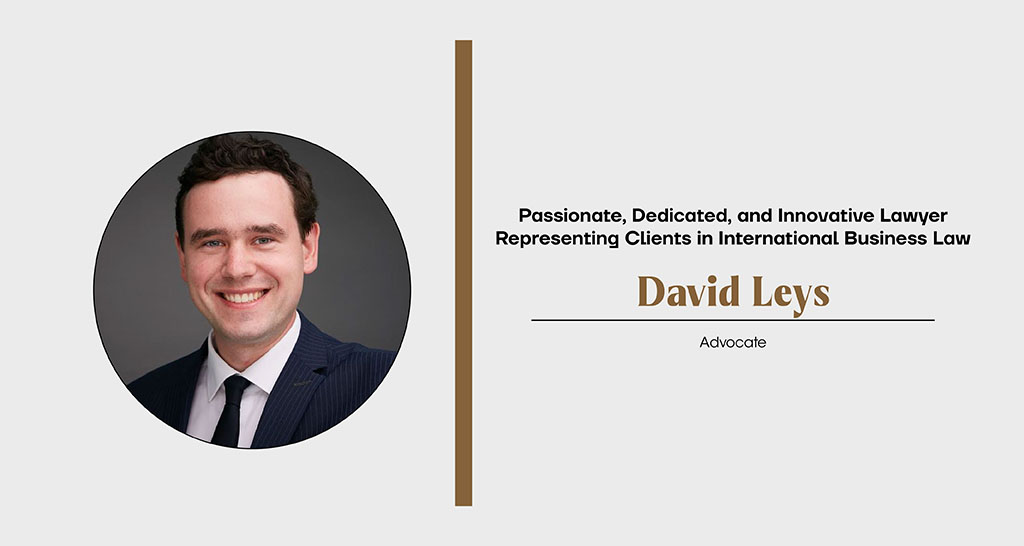
Meet David Leys, a global attorney who is a member of the Brussels Bar, specializing in international trade, data privacy (GDPR), intellectual property, antitrust and competition as well as corporate and commercial contracts. David pursued his legal education at the Université catholique de Louvain, the College of Europe, and Columbia Law School, where he enhanced his knowledge of international regulations and cross-border legal frameworks.
The Professional Journey
David received training at prestigious international firms Sidley Austin and McGuireWoods, where he provided counsel to Fortune Global five hundred companies, governmental bodies, and associations on issues that included trade remedies, customs disputes, and compliance with EU regulations.
Subsequently, David broadened his expertise to encompass data privacy and cybersecurity, serving as an external Data Protection Officer (DPO) and offering strategic advice on intricate GDPR implementation, cross-border data transfers, and the governance of digital risks.
David emphasized that his background in litigation is equally robust, having represented clients in court more than 300 times across various trial and appellate courts in Belgium, specifically in commercial, intellectual property, and contractual issues. This practical courtroom experience shapes his legal strategy and provides clients with a competitive advantage in negotiation, enforcement, or risk management.
At present, David integrates his legal practice with academic research and instruction. As a doctoral researcher at the Université catholique de Louvain, David concentrates on the regulation of digital commerce and emerging technologies such as 3D printing. He frequently contributes to international journals and guides the upcoming generation of legal professionals.
“Having visited 123 countries across all seven continents, I bring a deeply global mindset to my work,” added David.
“My extensive exposure to diverse legal cultures and business environments has sharpened my ability to negotiate across jurisdictions, manage cultural nuances, and deliver strategic legal advice with both precision and diplomacy.”
Area of Specialization
David focuses on five primary domains: international trade, data privacy and cybersecurity (GDPR), antitrust and competition, intellectual property, and corporate and commercial contracts, as these domains constitute the foundation of cross-border commerce and innovation.
Across all these fields, what motivates David is the ability to translate legal complexity into practical solutions and to give clients not only peace of mind, but a strategic edge.
Professional Achievements
One of David’s most notable professional accomplishments has been providing counsel and representation to high-profile clients, which include Fortune Global 500 companies, public institutions, and innovative entrepreneurs across various jurisdictions, all while establishing a practice that merges legal accuracy with strategic insight.
A significant achievement was his participation in a complicated EU merger control case for a Fortune 500 energy corporation, where he managed legal due diligence and competition submissions across multiple nations. This project necessitated the alignment of legal, regulatory, and commercial priorities under considerable time constraints, showcasing his capability to maneuver through EU competition law, internal governance, and geopolitical sensitivities at the highest echelon.
Going with the Trend
David emphasizes that remaining at the forefront of changing legal frameworks is crucial to his work, particularly when providing counsel to clients throughout the EU, the U.S., and international organizations. David addresses this challenge by employing a blend of strategic monitoring, ongoing education, and direct involvement with regulatory advancements.
Addressing the Legal Industry Challenges
David stated that the legal sector in Europe is experiencing significant changes, influenced by rapid regulatory developments, digital innovations, and geopolitical instability. Three specific challenges are particularly noteworthy:
Due to the overlapping layers of EU law, national legislation, and sector-specific frameworks, legal professionals encounter growing challenges in providing clear and harmonized guidance, particularly in cross-border situations. David tackles this issue by cultivating extensive vertical expertise in areas such as trade, data protection, and intellectual property, while also converting intricate legal structures into practical advice customized for each client’s sector and jurisdiction.
Europe is at the forefront of establishing global regulatory standards in data privacy, artificial intelligence, cybersecurity, and platform governance. However, clients frequently find it challenging to balance innovation with compliance. David’s practice is dedicated to closing this gap by creating contracts that comply with GDPR, providing guidance on cross-border data transfers, and analyzing evolving regulations such as the EU Digital Markets Act, the AI Act, and the Data Act with a future-oriented perspective.
Businesses are encountering heightened litigation risks, ranging from intellectual property enforcement to consumer protection and public procurement conflicts. The courts are inundated, and clients are seeking quicker, more strategic methods for dispute resolution. David addresses this by integrating extensive litigation expertise, which includes court appearances in Belgium, with pre-litigation risk evaluation and alternative dispute resolution strategies, enabling clients to resolve issues effectively and in a commercially viable manner.
Incorporating Technology
Innovation and technology are not peripheral to David’s legal practice they are integral to how David deliver value, anticipate risk, and stay ahead of the curve.
Initially, he incorporates legal technology tools into everyday operations to improve efficiency and accuracy. Ranging from contract lifecycle management systems to AI-powered compliance checkers and legal analytics platforms, David employs technology to facilitate document drafting, track regulatory updates in real time, and detect potential issues early in intricate contracts or tenders.
Secondly, he offers legal advice regarding technology. David guides clients on GDPR adherence concerning AI, algorithmic processing, cloud services, and international digital commerce. Additionally, David plays a role in shaping legal perspectives on new technologies, including the effects of 3D printing on trade law and the governance of data transfers within the EU–U.S. framework, through scholarly research and legal analysis.
Thirdly, he adopts a digitally proficient, client-oriented approach. Whether he is advising a startup on licensing strategies, reviewing a SaaS contract, or negotiating intellectual property clauses in a technology merger and acquisition deal, David communicates in the language of innovation. His clients are engaged in rapidly evolving industries ranging from entertainment to energy to digital platforms, and they expect legal counsel that comprehends their business models and anticipates changes in regulations.
Supporting Future Legal Professionals
Mentorship and leadership are fundamental to David’s approach to practicing law, team building, and contributing to the legal profession. He regards these elements not as optional, but as vital responsibilities, particularly in a legal environment that requires not only technical expertise but also sound judgment, adaptability, and integrity.
As a practitioner, he exemplified leadership: demonstrating strategic thinking, maintaining clarity in high-pressure situations, and committing to excellence in every file he manages, whether for a startup, a government entity, or a Fortune 500 client. However, effective leadership also entails being approachable. David dedicates time to elucidate not only what tasks must be accomplished but also the rationale behind them, while cultivating a learning atmosphere that enables younger professionals to develop with confidence and intellectual rigor.
The Future of Legal Services
The future of legal services in Europe will be shaped by integration, innovation, and purpose. The world is entering an era where legal advice must transcend traditional boundaries geographical, disciplinary, and institutional and evolve into a truly strategic service that enables clients to navigate complexity, harness change, and build trust.
David believes legal services will become increasingly tech-augmented, policy-aware, and impact-driven. European law is no longer limited to the courtroom or the boardroom, it is becoming central to questions of digital sovereignty, sustainable transition, and cross-border governance. Lawyers will need to combine regulatory expertise with geopolitical fluency, technological literacy, and ethical awareness.
Through interdisciplinary practice, scholarly research, and legal thought leadership, David seeks to articulate the characteristics of a next-generation European lawyer: multilingual, adept in cross-border matters, digitally proficient, and knowledgeable in policy. David aspires to create connections between law and technology, the private and public sectors, as well as between legal certainty and commercial innovation.