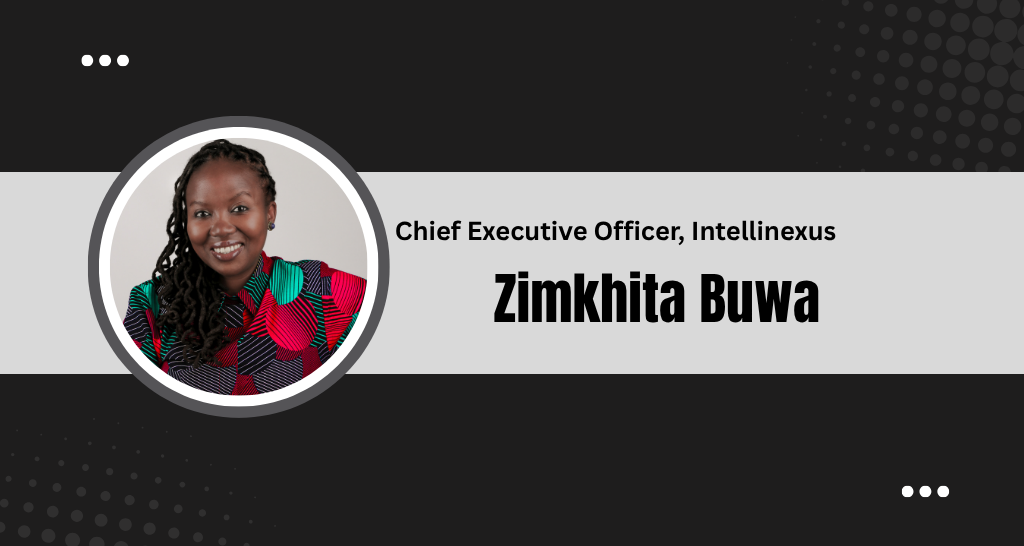
Interview with Zimkhita Buwa, Chief Executive Officer of Intellinexus

Zimkhita Buwa is the Chief Executive Officer of Intellinexus, a South African data advisory company focused on turning complex data into actionable insights that drive measurable business outcomes. With over 20 years of experience in innovation and digital transformation, her career spans roles across analytics, automation, and enterprise technology. She began her professional journey as an SAP Business Intelligence Analyst at an African-based energy group and went on to hold senior leadership positions, including Chief Operating Officer at a well-known software development company and Head of Intelligent Business Applications Core Practice at a global systems integrator and hybrid IT managed services provider. Prior to joining Intellinexus, she also served as CEO of a technology business operating in a digital-first, automation-led environment.

Zimkhita is widely recognised for her leadership style, which emphasises collaboration, innovation, and the empowerment of women and youth in the technology sector. She is a strong advocate for using data to enable informed decision-making and sustainable growth and has served as a non-executive director on the board of Rogerwilco, an award-winning digital marketing agency. Her accolades include the MTN Outstanding Women in ICT Award, the ICT category win at the 2017 Rising Star Awards, and a nomination in the Global Hero category at the Digital Female Awards in Germany. She holds an Honours degree in Information Systems from Universiti Teknologi Petronas in Malaysia and a Leadership Development certification from IE Business School in Spain. Through her industry involvement and community initiatives, Zimkhita is regarded as a trailblazer and servant leader committed to driving excellence, inclusion, and meaningful impact.

Here are the key highlights from the interview:

Can you share your leadership journey and the defining moments that inspired you to build and lead Intellinexus as a purpose-driven organisation?

My leadership journey spans more than twenty years in innovation and digital transformation, beginning as an SAP Business Intelligence Analyst at an African-based energy group and progressing through senior executive roles in software development, systems integration, and digital transformation. Over time, I have led teams across complex environments, including serving as COO and later as CEO in technology-driven organisations.

A defining moment came in 2013 when I was selected as a TechWomen Emerging Leader by the U.S. Department of State, exposing me to global perspectives on innovation and mentorship. This, combined with winning the MTN Outstanding Women in ICT Award in 2016, reinforced my commitment to empowering women in tech and fostering inclusive ecosystems.

What has consistently shaped my approach is seeing how data, when used responsibly, strategically and with intent, can fundamentally change how organisations operate and more importantly shape societies progress.

When I joined Intellinexus as CEO in April 2024, it felt like a natural evolution. I was drawn to the company’s purpose-driven ethos, aligned values, and shared belief with the founder, Jacques du Preez that data is not only a commercial asset, but a catalyst for broader impact. Purpose, for me, is about enabling better decisions, building strong data cultures, and creating environments where people and organisations can truly thrive.

What inspired me to lead this organization is its alignment with my vision of the “Data-Domino Effect”—where data strategies create cascading positive impacts, from enhanced decision-making to societal progress in areas like financial inclusion, healthcare, and education.

What core problem does Intellinexus aim to solve for businesses today, and how does your approach differ from traditional consulting or advisory models?

Many organisations have access to vast amounts of data but struggle to turn it into insight they can tangibly use. The core problem we help solve is translating data into meaningful, actionable intelligence that supports confident decision-making at every level of the organisation.

What sets our approach apart is that we are fundamentally business-led. Rather than offering generic advice, we work as strategic data leaders, bringing together innovation, deep expertise, and access to the right talent to support real outcomes.

The focus is on building internal client capability, embedding strong governance, and creating a culture where data informs everyday decisions. The goal isn’t a short-lived win, but long-term value and independence. Our proven track record with regional and global clients demonstrates how we build resilient, long-term partnerships over transactional engagements.

As CEO, which leadership values and principles guide your decision-making and shape the culture of Intellinexus?

Human connection, trust, and authentic communication sit at the heart of our leadership approach. As a leadership team, we believe strong relationships enable better collaboration, empowered teams, and more sustainable outcomes for both employees and clients.

At Intellinexus, this means actively listening, asking difficult questions, and applying what we learn. Leadership is not about having all the answers, but about creating an environment where people feel heard, respected, and empowered to contribute. Integrity, accountability, and continuous learning are essential to maintaining a culture that supports both performance and purpose.

What major trends or disruptions do you see reshaping your industry, and how is Intellinexus strategically preparing to stay ahead of these changes?

The rapid evolution of cloud technologies, data platforms, and artificial intelligence is reshaping how organisations compete and operate. However, technology adoption without strong leadership commitment, governance, and data culture often leads to missed opportunities.

The data and AI industry is being reshaped by several major trends and disruptions, including the rapid advancement of generative AI and machine learning, heightened focus on data privacy and ethical AI (driven by regulations like GDPR and POPIA), the rise of edge computing for real-time analytics, and the integration of AI with sustainability initiatives to address global challenges. In Africa, we’re also seeing skills gaps and infrastructure hurdles, but these are offset by explosive growth in digital transformation and modernisation.

Intellinexus is preparing for these changes by investing in talent sourcing to bridge skills gaps, offering specialised professionals for digital projects and focusing on responsible use of data, ethical AI implementations and leadership enablement. We help organisations understand not only what is possible, but what is practical and sustainable. By strengthening foundations and encouraging collaboration across teams and partners, we enable businesses to move faster without increasing risk.

What have been some of the most challenging moments in your leadership journey, and how have they contributed to your personal and professional growth?

Leadership transitions are inherently disruptive, both for teams and for clients. Stepping into the CEO role at Intellinexus reinforced the importance of stability, alignment, and continuity during periods of change.

Throughout my leadership journey, I’ve faced several challenging moments that have profoundly shaped my growth. One significant hurdle was managing the complexities of digital transformation during my time at a system integrator, where implementing intelligent business applications across diverse MEA regions required overcoming cultural, regulatory, and infrastructural barriers. This tested my resilience but taught me the importance of adaptive leadership and stakeholder alignment, ultimately strengthening my ability to drive cross-border collaborations.

Another pivotal challenge came during my tenure as CEO during the global pandemic, when supply chain disruptions and remote work shifts demanded rapid pivots to cloud-based solutions. Balancing team well-being with business continuity was tough, but it reinforced the value of empathy and agile decision-making.

These moments have deepened my appreciation for clear, transparent communication and shared leadership. Growth often comes from listening carefully, acknowledging uncertainty, and making deliberate choices that balance immediate pressures with a longer-term vision.

What does success look like for Intellinexus over the next few years, and what impact do you hope the organisation will have on clients and the wider business ecosystem?

Success for Intellinexus is measured by impact rather than scale alone. We aim to help organisations build strong data strategies that drive productivity, innovation, and new revenue opportunities, while also contributing to social progress across sectors such as healthcare, education, and financial inclusion.

I hope Intellinexus continues to play a role in shaping Africa’s data capability, supporting leaders to think bigger, move faster, and collaborate more effectively. When data cultures are strong, organisations become more transparent, more agile, and better equipped to serve their communities. Ultimately, success for us is about leaving a legacy of empowered organisations and communities thriving in a data-centric world.

What advice would you offer to aspiring entrepreneurs and leaders who want to build future-ready organisations with purpose and impact?

My advice is to adopt a “think bigger, be bolder, move faster” mindset. Don’t shy away from ambitious visions, especially in tech and data. Be clear about your purpose and ensure it is reflected in how you lead, how you make decisions, and how you treat people. Invest in building strong cultures, not just strong products.  For me, it’s also been about leveraging data for societal good, which has guided every decision at Intellinexus.

Seek mentorship and networks, like I did through TechWomen and the African SAP User Group, to gain diverse perspectives and support. Foster inclusivity; diversity in teams drives creativity and resilience. Be agile in the face of disruptions, pivot quickly, but always with integrity and transparency.

Leaders must also be willing to think boldly, collaborate openly, and commit to continuous learning. Technology will continue to evolve, but organisations that succeed are those that prioritise people, trust, and responsible use of data to create meaningful, lasting impact. With passion and perseverance, you can build organisations that not only succeed but transform lives. Africa’s tech landscape is ripe for it, so seize the opportunity!

📌 Zimkhita Buwa – LinkedIn

🌐 Intellinexus – Company Website

AI and RegTech: A Compliance Leader’s Perspective from the UAE to the Global Stage

I am Hemanth Kumar, currently serving as Chief Compliance Officer at Federal Exchange in the United Arab Emirates. Over the last 15 years, I have worked across compliance, risk management, and regulatory technology, spanning the UAE, India, Hong Kong, Singapore, and the UK. I hold certifications including CAMS, CRCMP, ICA Specialist in AI Compliance, and CCE (Crypto Expert).

Much of my career has been shaped by exposure to global standards FATF framework and its application across regions. I have also had the privilege of contributing thought leadership on compliance and technology innovation, including perspectives on RegTech and AI integration.

As someone deeply engaged with both traditional financial frameworks and emerging regulatory expectations in the virtual asset space (under regulators such as VARA and ADGM), I approach compliance not only as a rulebook-driven responsibility but as a human-led mission to safeguard trust in financial systems.

The Evolving Compliance Landscape

In today’s globalized economy, compliance is no longer a back-office function — it is a strategic pillar of organizational resilience. FATF standards have created a common global language, but implementation varies widely across jurisdictions.

The UAE, where I currently practice, has emerged as a regional hub by aligning with FATF’s evolving expectations. The country’s removal from the FATF grey list in 2024 was not accidental — it was the result of targeted reforms in supervision, risk-based approaches, and cross-border cooperation.

What this demonstrates is simple: compliance is no longer just about “following the rules.” It is about proving effectiveness, demonstrating that systems and processes are not only in place but are actually preventing illicit financial flows.

Yet the challenge remains: the sheer scale and complexity of transactions in a borderless financial system make it humanly impossible to monitor risks without technological augmentation. This is where RegTech and AI enter the conversation.

AI as a Game-Changer in Compliance

Artificial intelligence is not science fiction in compliance — it is already here. From sanctions screening to transaction monitoring, from biometric onboarding to predictive analytics, AI is rewriting the way institutions detect, assess, and mitigate risks.

Take sanctions screening as an example. Traditional systems often generate overwhelming false positives, consuming valuable analyst hours. AI-driven alert calibration, on the other hand, can reduce false positives by learning patterns, refining rules, and highlighting true risks with higher accuracy.

Similarly, in transaction monitoring, AI modules can detect anomalies that rule-based engines miss — such as hidden layering in cross-border remittances or crypto-to-fiat conversion risks. AI’s predictive capability enables compliance teams to move from reactive investigations to proactive prevention.

But here lies the caution: AI is not infallible. Algorithmic bias, lack of explainability, and over-reliance on automation can create blind spots. In my experience, the most effective compliance programs are those that treat AI not as a replacement for human judgment but as an enhancement of it.

RegTech and Human Judgment: Striking the Balance

RegTech has transformed compliance efficiency, but technology alone cannot safeguard integrity. I often remind my teams that systems are only as strong as the values of the people who design, monitor, and interpret them.

Over the years, I have seen cases where institutions invested heavily in systems yet failed compliance audits — not because the technology was inadequate, but because governance, accountability, and ownership were missing.

This is where ideology and leadership matter. Compliance leaders must ensure that RegTech solutions are not simply deployed but meaningfully integrated into a culture of responsibility. AI can scan millions of transactions in seconds, but it takes a human leader to ask: Are we asking the right questions? Are we willing to act when the answers are uncomfortable?

For me, the intersection of technology and human ethics is where the true future of compliance lies.

Global Lessons from the UAE Corridor

Working in the UAE has given me a front-row seat to one of the most dynamic regulatory environments in the world. The UAE is unique because it must manage traditional banking, sprawling remittance corridors, and the fast-emerging virtual asset ecosystem simultaneously.

When FATF called for stronger action, the UAE responded with entity-wide risk assessments, strengthened sanctions frameworks, and dedicated virtual asset regulations through VARA. These were not mere check-the-box exercises — they were structural changes aimed at embedding compliance into the DNA of institutions.

For example, under VARA, Virtual Asset Service Providers (VASPs) must demonstrate not just KYC procedures but ongoing monitoring, transaction surveillance, and travel rule compliance. This mirrors FATF’s Recommendation 15 but adds a local layer of accountability tailored to Dubai’s market.

The lesson for global compliance leaders is clear: adopting FATF standards is not enough. Each jurisdiction must adapt those standards to its unique risk environment, and each institution must internalize them as part of daily operations.

Future Outlook: AI, Trust, and the Human Role

As compliance professionals, we often discuss what technology can do. I believe the next conversation must also focus on what technology should not do.

AI should not replace the ethical compass of human judgment. AI should not dilute accountability by allowing leaders to defer responsibility to algorithms. And AI should never become an excuse for complacency in governance.

The future of compliance will be defined by hybrid models — where AI provides the speed, scale, and precision, and humans provide the judgment, values, and courage to act. Regulators, too, are evolving. The EU’s AI Act, for instance, requires explainability and accountability in high-risk AI applications. This is a reminder that even as we innovate, we must remain transparent.

For me, the essence of leadership in this space is about more than compliance. It is about trust. Institutions that use AI responsibly, transparently, and ethically will not only satisfy regulators — they will earn the confidence of customers, partners, and the global community.

Conclusion

We are entering a new era where compliance cannot be separated from technology, and technology cannot be separated from values.

AI and RegTech will continue to redefine the efficiency of compliance programs, but they cannot replace the role of ethical leadership. At the end of the day, compliance is not about machines or systems — it is about people protecting people, safeguarding economies, and preserving the integrity of global financial systems.

As someone who has lived through audits, regulatory reforms, and cross-border challenges, my conviction is simple: AI is an enabler, but human leadership is irreplaceable.


Hedley Lewis: Leading CHOC with Compassion and Purpose

Hedley Lewis, the Chief Executive Officer of CHOC Childhood Cancer Foundation South Africa, is a compassionate and visionary leader dedicated to improving the lives of children battling cancer and life-threatening blood disorders. With a strong background in leadership and social impact, Hedley has been instrumental in expanding CHOC’s national reach and enhancing its support programs. His commitment to community service and child welfare drives his mission to ensure that no family faces the cancer journey alone. Under his guidance, CHOC continues to deliver holistic care and advocacy with empathy and excellence.

Here are the key highlights from the interview:

Q1. Brief the inception story of your organization? What inspired you to establish and follow the mission and vision of CHOC?

Inception Story


CHOC was founded in 1979 by a small group of dedicated parents whose children were undergoing cancer treatment. Faced with the overwhelming emotional, financial, and logistical challenges of navigating childhood cancer, they came together to create a support system that would ease the burden for other families. What began as a grassroots initiative has since grown into a nationally recognized organization, offering comprehensive care and advocacy for children with cancer and life-threatening blood disorders.

CHOC is a registered and internationally recognized Non-Profit Organisation (NPO), providing holistic support to children and teenagers with cancer and life-threatening blood disorders, as well as their families. Our services span the country, reaching both urban and rural communities across South Africa.

CHOC serves the childhood cancer community in South Africa; however, CHOC’s reach goes much further. We reach out to communities and serve individuals by offering a range of services. Through Childhood Cancer International, CHOC supports our sister organisations in the Sub-Saharan African countries by building capacity and sharing information.

◦ CHOC Programmes include accommodation, transport to and from treatment centres, Financial Transport Assistance, and Awareness Training and Education Programme on the Siluan Early Warning Signs of Childhood Cancer.

◦ Emotional Support (both professional and non-professional) for children, teenagers and their families through their cancer journey as well as palliative, end-of-life care and bereavement support.

◦ Patient Support for patients and families, including essential CHOC Carebags, nutritional food support, and bereavement services.

Professional Emotional Support (Psychosocial Support Services)

CHOC provides psychosocial support to children, teenagers, and their families to help them cope with the numerous new demands on the family and to provide relevant information to assist them.

CHOC employs a team of social and social auxiliary workers who provide full-time psychosocial support in the Paediatric Oncology Units, from diagnosis to the end of treatment or end-of-life care, where we also offer bereavement and grief support.

Emotional Support (Parental and Family Support)

Trained volunteers provide comprehensive emotional support to children, teenagers, and their families. We offer support groups for survivors, as well as a Parent-Supporting-Parent Programme, which provides support to parents whose children have been newly diagnosed with cancer through group discussions, and during parent tea’s at the Paediatric Oncology Units.

The psychosocial team provide support to parents and families through bereavement and grief counselling. Every year at the end of November, Remembrance Services are held nationwide. During the Remembrance Services, CHOC remembers the children and teenagers who bravely fought and sadly lost their lives. It is a chance for us to stand together with the families and doctors and pay tribute to these children and teenagers.

CHOC Education Programme

The iPad Learning Programme, facilitated by iSchool-Africa, commenced in May 2024 with CHOC Childhood Cancer Foundation SA. This initiative supports paediatric oncology patients by ensuring their education continues despite the challenges posed by cancer treatment and prolonged hospital stays. The programme brings iPads loaded with engaging content directly to children and teenagers undergoing cancer treatment. The goals include reducing anxiety, minimising learning loss, and assisting with various therapies. Comprehensive training is provided to hospital school teachers and teacher consultants to integrate the technology effectively into the children and teenagers’ routines and educational plans.

Vision & Mission

Vision: All children and teens with cancer or life-threatening blood disorders have comprehensive access to care and support.


Mission: Supporting children and teenagers with cancer and life-threatening blood disorders, and their families; improving early detection and augmenting effective treatment.

What This Means to Families


For the children, teenagers and families we serve, CHOC’s mission and vision translate into hope, dignity, and practical support during one of life’s most difficult journeys. The organisation stands as a lifeline ensuring that no child faces cancer alone and no parent is left without guidance.

Since transitioning from the corporate world to the nonprofit sector, I’ve found deep purpose in lending my voice to children whose own voices are often faint or unheard. CHOC’s impact supporting over 1,700 children annually, delivering thousands of bed nights, and offering psychosocial care to families nationwide, showed me the power of compassion in action. It became clear that I wanted to be part of an organization where, I can assist in reshaping the landscape of Paediatric Oncology in South Africa by empowering communities, strengthening healthcare partnerships, and ensuring that childhood cancer is met with expertise, empathy, and unwavering support.

Q2. What were some of the most significant challenges you faced during the early stages, and how did you navigate them as a leader?

When I transitioned from the corporate world into the nonprofit sector, I knew I was stepping into something far more personal and purpose-led But that shift came with its own set of challenges.

One of the first hurdles was adapting to a resource-limited environment. In corporate settings, you often have access to tools, teams, and budgets. In the non-profit world especially in healthcare, you learn to do more with less. It required a complete shift in mindset and leadership style.

Then came the emotional weight. Working with children and teenagers who have been diagnosed with cancer and their families is profoundly humbling. You’re not just managing programmes; you’re walking alongside people in their most vulnerable moments. That demands compassion, resilience, and a kind of leadership that listens more than it speaks.

Funding was, and still is, a constant challenge. Sustaining programmes such as accommodation, transport, nutritional support, and psychosocial care requires continuous advocacy, donor trust-building, and demonstrating tangible impact. However, having a strong, supportive team and board is absolutely vital to achieving CHOC’s mission. I’m deeply grateful for the collaboration, dedication, and shared vision that carry us through every challenge we face. It’s through this united effort that we continue to make a meaningful impact in the lives of children with cancer and their families.

Raising awareness in underserved communities also remains a significant challenge. Early detection saves lives, yet stigma and misinformation persist. That is why advocacy and education have become central to CHOC’s mission.

Through it all, I’ve leaned on purpose, empathy, and collaboration. I’ve worked closely with paediatric oncologists, government departments, volunteers, and donors, because leadership in this space is not about standing alone, it’s about standing together.

If I’ve learned anything, it’s this: resilience is not just about bouncing back, it’s about staying grounded in your mission even when the road gets tough. That’s what keeps me and CHOC moving forward.

Q3. In today’s rapidly evolving business world, what core values and leadership traits do you believe are most important for long-term success?

Childhood cancer advocacy isn’t just a healthcare issue; it’s a human rights issue. The next generation of African leaders must be bold enough to challenge broken systems, compassionate enough to walk with families, and visionary enough to build a future where no child is left behind.

True leadership in this space must begin with compassion. Every decision affects real lives, children determined to survive and families navigating grief and uncertainty. Compassion builds trust, and trust builds resilience.

Leaders must also be a voice for the voiceless. Across Africa, too many children and teenagers are diagnosed too late due to stigma and lack of awareness. We must influence policy, engage media, and fight for equity.

Beyond treatment, we must build systems of holistic support that empower families. At CHOC, we provide accommodation, nutritious meals, transport, and psychosocial care. These are not luxuries; they are lifelines.

Collaboration is essential. We work hand-in-hand with paediatric oncologists, nurses, social workers, government, and NGOs. Our partnerships with SAPHO and the Tumour Registry are examples of how collective effort creates systemic change.

Finally, leaders must remain resilient and purpose driven. The work is tough, funding is limited, and the emotional toll is heavy. But the mission is too important to abandon. At CHOC, we stay focused on the children, we adapt, we grow, and we keep showing up.

To the next generation of leaders: lead with heart, build with vision, and never forget who you’re doing it for.

Q4. In your opinion, what are the key qualities required for a successful leader in today’s business environment?

Leadership, particularly in the non-profit healthcare sector, is impossible without a strong and passionate team. At CHOC Childhood Cancer Foundation SA, our regional teams, social workers, and volunteers, work near paediatric oncology units across the country, ensuring that families receive consistent, practical, and emotional support during the most challenging times of their lives.

This frontline presence is backed by a robust finance and governance framework, along with a dedicated HR function that empowers staff to focus on what matters most while supporting children, teenagers and their families. With systems in place to ensure compliance, transparency, and operational efficiency, our teams can channel their energy into care, advocacy, and impact.

Strong fundraising programmes, driven by empathy and strategic execution, allow CHOC to sustain and grow its services. Our staff and volunteers gain immense personal and professional fulfilment from the work they do, witnessing the resilience of adolescents, the gratitude of families, and the tangible difference their efforts make in the lives of others. This work cultivates a deep sense of purpose, compassion, and unity across the organisation.

At the heart of this cohesive and mission-driven culture as the CEO, my leadership brings together diverse teams under a shared vision of excellence, compassion, and accountability. I ensure that every part of CHOC from governance and fundraising to frontline support is aligned and working collaboratively. My ability to inspire, connect, and lead with integrity has been instrumental in building a united organisation where every team member feels valued, supported, and driven by the cause.

Together, CHOC’s people form a powerful force for good, one that not only uplifts children and teenagers with cancer and their families but also strengthens the broader healthcare and non-profit landscape in South Africa.

Building on this foundation, I believe the following leadership qualities are essential:

  • Authenticity: Great leaders are grounded in who they are, lead with integrity, and are not afraid to show vulnerability.
  • Empathy and compassion: Emotional intelligence is non-negotiable. Understanding your team and community builds trust and resilience.
  • Visionary thinking: Leaders must inspire others toward a better future, anticipating change and embracing innovation.
  • Adaptability: The world is fast-changing. Leaders must be agile, open to feedback, and committed to lifelong learning.
  • Collaboration and influence: Leadership today is about building coalitions and empowering others, not controlling them.
  • Resilience: Setbacks will come, but true leaders remain steady, model perseverance, and inspire others to do the same.
  • Strategic communication: Clear, transparent, and inspiring communication aligns people with purpose and drives culture and impact.

Q5. What advice would you offer to the next generation of entrepreneurs and leaders across Africa?

My advice is simple but profound: lead with empathy. In our field, compassion isn’t a luxury, it’s a necessity. Every child we serve is more than a diagnosis; every caregiver is more than a support system. They are the heartbeat of our mission.

Build systems that wrap around the family holistically – medically, emotionally, logistically, and socially. At CHOC, we’ve seen how something as simple as a warm bed, a meal, a transport voucher, or a listening ear can transform a family’s experience.

Embrace innovation from data-driven treatment plans to mobile health tools but ensure that technology serves humanity and reaches even the most remote communities.

Above all, embrace collaboration. At CHOC Childhood Cancer Foundation SA, partnership is not just a strategy, it’s a lifeline. We actively engage with a wide network of stakeholders including government departments, public and private hospitals, NGOs, corporates, and community organisations. These relationships are foundational to our mission of supporting children with cancer and their families. These alliances are deeply meaningful. They reflect a shared commitment to dignity, hope, and healing. Every stakeholder plays a role in the journey of a child or teenager who has been diagnosed with cancer, and CHOC is proud to be the thread that weaves these efforts together

To young African leaders: be bold, be kind, and be relentless. The children of this continent deserve nothing less.

I’ve had the privilege of surrounding myself with an exceptional team, and I truly believe I work alongside some of the most dedicated and compassionate individuals. Together, we are not just colleagues—we are a united force making a meaningful difference in the lives of children with cancer. I’m deeply honoured to work with people who bring heart, purpose, and unwavering commitment to everything they do.

Q6. What do you see as the most impactful trends or transformations shaping your industry in 2025 and beyond?

The childhood cancer field is undergoing profound transformation, driven by innovation, collaboration, and equity.

We are at a turning point. In high-income countries, survival rates for childhood cancer exceed 80%, while in many parts of Africa, survival is just 20%. This disparity is unacceptable—it is a call to action.

Global initiatives such as the WHO Global Initiative for Childhood Cancer (CureAll framework) are working to raise survival rates to 60% by 2030. For CHOC, this means deepening our involvement in public health, advocacy, and grassroots awareness.

Families affected by childhood cancer face immense psychological, emotional, financial, and logistical challenges. Many experiences strain due to travel distances to treatment centres, lack of nearby accommodation, out-of-pocket expenses, and disruptions to family life. The burden is shared not only by patients, but also by parents, siblings, and caregivers. As reflected in the global campaign #WeAllLiveIt, when a child is diagnosed with cancer, the entire family embarks on the journey together. But medicine alone is not enough. Healing requires wraparound support, beds near hospitals, nutritious meals, transport assistance, and psychosocial care. CHOC’s integrated model is designed to provide this, and it is increasingly being recognised as best practice worldwide.

Collaboration is another key driver. Governments, NGOs, hospitals, and the private sector are working together like never before. CHOC’s partnerships help shape national policy and strengthen healthcare systems from the ground up. The Department of Health, NCR, CHOC, SAAPHO, and WHO commend the dedication of healthcare professionals, support organisations, and members of the public who offer vital care and compassion to children with cancer. The NCR remains committed to ensuring accurate data collection and analysis to inform decision-making and improve outcomes.

Finally, the voices of survivors are reshaping the conversation. Their stories guide how we design programmes and ensure long-term healing.

The future of childhood cancer care will be more connected, compassionate, and equitable and CHOC is determined to help lead that transformation.

Q7. Brief us about your future roadmap.

Our future roadmap is focused on both strengthening and innovating:

  • Enhancing existing programmes to further reduce treatment abandonment rates.
  • Expanding awareness campaigns, across South Africa, ensuring no environment is overlooked, to educate communities on the early warning signs of childhood cancer.
  • Innovating support models, leveraging digital tools, expanding accommodation and nutritional programmes, and strengthening psychosocial services.
  • Building stronger collaborations with government, hospitals, and NGOs to unify efforts under paediatric oncology units.
  • Empowering survivors and families to share their voices, guiding us in creating more relevant and compassionate programmes.

Our vision for the future is clear: a South Africa where no child faces cancer alone, where early detection is the norm, and where every family receives the support they need to stay strong and hopeful.

An Interview with Dan Yogev Kaznelson of EL AL Israel Airlines

Dan Yogev Kaznelson is a visionary leader in the aviation industry, currently driving digital and operational innovation at EL AL. With a background in IT and project management, he has built a career around leveraging technology to transform complex systems and enhance efficiency. His leadership style emphasizes collaboration, inclusivity, and empowering teams to co-create impactful solutions. Under his guidance, EL AL has embraced digitalization, AI-driven tools, and customer-centric innovations to stay competitive in a rapidly evolving market. Widely respected for bridging technology and people, Dan continues to shape the future of aviation with strategic foresight and a passion for meaningful impact.


Here are the key highlights from the interview:

1. Can you share the story of your professional journey and what inspired you to pursue a career in the aviation industry?

My career has been driven by a passion for technology, problem-solving, and operational excellence. I began in project management and IT, where I discovered how digital solutions can transform complex environments. Aviation stood out because it’s a truly complex industry with multiple interconnected systems, where every day is different and no two days are the same. It’s an environment that constantly demands flexibility and the ability to react quickly to change, which aligns perfectly with my interest in strategic thinking and innovation. The opportunity to apply technology to create meaningful impact across people and operations inspired me to dedicate my career to this dynamic field.

2. How did your early experiences shape your leadership style and vision for driving innovation at EL AL?
Early in my career, I realized that successful leadership is about listening as much as directing. Working in project management and IT taught me to understand people’s perspectives, involve them in shaping solutions, and harness their potential. I also developed a habit of asking key questions for every initiative: What value does this bring? How will it benefit the organization? At EL AL, this approach drives inclusive innovation, where employees are active participants in valuable projects. I maintain an open mind, encouraging everyone to share new ideas, because those closest to the work often have the best insights. By building strong partnerships across teams and fostering open dialogue, I’ve learned that sustainable innovation emerges when people feel empowered, engaged, and part of the journey.

3. What drew you specifically to focus on aviation and airline management, and how has your role evolved over time?
Aviation drew me because it’s a highly complex, dynamic industry where multiple systems interact, and no two days are ever the same. It challenges you to react quickly to change and make decisions that ripple across the entire organization. I initially focused on IT and digital projects, but over time my role has evolved to overseeing broader operational and digital strategies, integrating technology and processes. Several projects have also improved the employee experience, which in turn has had a positive impact on the passenger experience. Today, I work to enhance efficiency and ensure EL AL remains innovative, agile, and future-ready.

4. How has EL AL adapted its services to meet the evolving expectations of travelers and the changing dynamics of the aviation industry?

EL AL has embraced innovation, digitalization, and AI-driven solutions to meet the evolving expectations of passengers. We have introduced new services and self-service options that make the travel experience more convenient, flexible, and personalized. At the same time, we continuously improve operational processes, enabling smarter decision-making and more efficient day-to-day operations. Passengers now receive real-time updates and enhanced support, reflecting our commitment to seamless, technology-enabled experiences. By combining these elements, EL AL stays agile, innovative, and ahead in a competitive aviation landscape.

5. What were the most significant challenges you faced in leading within such a highly competitive and regulated industry, and how did you overcome them?

One of the greatest challenges in aviation is leading transformation in a highly regulated and competitive environment. Regulatory requirements, complex systems, and naturally cautious mindsets often make change difficult. I overcame this by learning from leading companies in the industry, drawing insights from colleagues at other airlines, and approaching problems with creative, out-of-the-box thinking. At the same time, I emphasized collaboration, building strong partnerships across departments, and fostering open dialogue, ensuring that every change was understood, embraced, and delivered clear value. This approach has proven essential in driving successful innovation in a complex environment.

6. How do you ensure EL AL remains competitive and relevant in a fast-changing global aviation landscape?

To stay competitive, EL AL focuses on continuous innovation, operational excellence, and customer-centric solutions. We invest in digital tools, AI-driven systems, and self-service platforms that enhance efficiency and improve the passenger experience. At the same time, we nurture a culture of collaboration, learning, and agility, ensuring that new ideas are tested, refined, and implemented effectively. By combining strategic technology adoption with strong operational practices, EL AL remains adaptive, resilient, and positioned to lead in a rapidly evolving global aviation market.

7. What advice would you give to young professionals who aspire to build a career in aviation and airline management?

For young professionals aspiring to a career in aviation, I would advise them to remain curious, embrace challenges, and think boldly. Seek opportunities to learn and make a meaningful contribution by addressing problems, and take lessons from both successes and setbacks while maintaining adaptability in a fast-paced industry. Cultivate relationships and surround yourself with individuals who challenge you and help you achieve your full potential. Above all, strive to make a tangible impact—through innovation, collaboration, practical engagement, and persistence in bringing ideas to fruition.

9. How do you see the aviation industry evolving over the next 5–10 years, and what role do you envision EL AL playing in shaping that future?

The aviation industry will continue to experience strong growth over the next decade, driven by rising passenger demand and global connectivity. Digitalization will play a central role, with intelligent, data-driven systems, AI, self-service solutions, and flexible platforms transforming how airlines operate and anticipate passenger needs. EL AL has already initiated its digital transformation, and as an Israeli company in the “Startup Nation,” we are committed to adopting emerging technologies and becoming a fully digital airline. Our focus is on delivering efficient, seamless, and personalized experiences, while leading the next generation of innovation and shaping the future of aviation.

10. How would you like your leadership and contribution to the aviation sector to be remembered?

I hope to be remembered as a leader who bridged technology and people, turning innovative ideas into meaningful impact. My goal has always been to improve operational processes, enhance experiences, and empower teams to perform at their best. I want my contribution to reflect a commitment to innovation, collaboration, and practical results, leaving a legacy that not only advanced EL AL but also helped shape the broader aviation industry for the better.

11. Is there anything specific you would like to highlight about EL AL’s journey, achievements, or impact that you feel would inspire our readers?

EL AL’s journey in recent years demonstrates the power of vision, innovation, and perseverance. Following the challenges of COVID, EL AL rebuilt itself as a new-generation airline, redefining how we operate and serve our passengers. Projects I have led—such as EFF, Trip Trade, ACC and many more—have showcased how strategic technology adoption can transform operations and drive efficiency, with several receiving international recognition and awards. Beyond these achievements, EL AL has consistently maintained 5-star customer service ratings across multiple years, a testament to our dedication to excellence. Together, these milestones highlight what is possible when technology, people, and strategy align, and I hope they serve as inspiration for others to embrace innovation and create meaningful impact in their own industries.

Interview with Kelly Augspurger, Co-Founder of Steadfast Insurance, LLC

An inspiring conversation highlighting her entrepreneurial journey, leadership insights, and the innovative approach driving Steadfast Insurance’s success.

Can you share your professional journey and the inspiration that led you to co-found Steadfast Insurance? What motivated you to focus on this industry?

My husband, Adam, and I co-founded Steadfast Insurance LLC in 2019 with a shared vision to help families protect what matters most. In the beginning, I focused on life insurance while Adam managed property and casualty. About six months later, a conversation with a mentor changed everything.

She reached out with questions about long-term care insurance (LTCi). I didn’t have the answers, but that moment lit a fire in me to find them. Memories of all four of my grandparents needing extended care came rushing back. None of them had insurance or a plan in place, and our family carried the weight – physically, emotionally, and financially. I helped care for one of my grandmothers firsthand, and I’ll never forget how hard that season was.

That conversation became my “aha” moment. I knew that this was the work God was calling me to do – to help families plan, so they could face future care needs with confidence and compassion. Once I realized there were real insurance solutions to fund that kind of care, I was all in.

From there, I dove deep into learning everything I could about long-term care planning and insurance. I earned three professional designations: CLTC® (Certification for Long-Term Care), CSA® (Certified Senior Advisor), and LTCCP® (Long-Term Care Claims Professional)and began creating educational videos and resources to simplify this complex topic for families and financial professionals alike.

In 2022, I became a part-time CLTC® instructor, training financial advisors on how to engage their clients in meaningful LTC planning conversations. That same year, I launched the Steadfast Care Planning Podcast, where I interview industry experts and advocates about how to navigate aging, caregiving, and extended care with wisdom and grace.

What started as one conversation has grown into a clear mission – to help families protect their future, preserve their options, and experience peace of mind.


What is the core vision and mission behind Steadfast Insurance, and how do you believe your company is driving meaningful change in the insurance sector?

At Steadfast Insurance LLC, we recommend the policies and coverage that we believe will best protect our client’s quality of life if a claim occurs. Our vision with extended care planning is to help families create a plan, fund it, and share it with those they love so they can face the future with confidence, not fear.

Our mission is rooted in education and empathy. We believe clients make their best decisions when they understand their options, so we take the time to teach them what’s available. Every recommendation we make is personalized around the client’s unique situation – health, family dynamics, financial situation, and personal values to protect their quality of life if a claim occurs.

Beyond one-on-one guidance, we’ve built an entire ecosystem of educational resources such as videos, podcast episodes, blog posts, and downloadable guides to help people learn in whatever way suits them best. That commitment to clarity and accessibility has helped us stand out and reach clients nationwide.

We also strive to modernize how long-term care and extended care planning are delivered. Our online health prescreen form allows clients to share sensitive information privately and securely, and Zoom consultations make expert guidance accessible from anywhere. Electronic applications further streamline the process, saving clients time and stress.

Ultimately, Steadfast is driving change by blending compassion with technology bringing human connection and convenience together to make care planning simpler, smarter, and more personal.


As a woman leader in a competitive industry, how do you approach leadership and innovation to keep Steadfast Insurance ahead in the evolving marketplace?

Leadership:
I believe great leadership starts with humility, service, and continuous growth. I’ve been blessed by mentors who’ve supported me both personally and professionally and I try to pay that forward every chance I get. My leadership philosophy is simple: serve others, show integrity, lead with compassion, and give credit where it’s due. Comparison is a trap that robs us of perspective, so I focus instead on progress – how far I’ve come, what’s working, and where I can grow. I encourage others to do the same so they can discover their strengths, develop new ones, and take courageous, measured risks. Confidence and curiosity go hand in hand; one gives you the courage to step forward and the other keeps you learning once you do.

Innovation:
For me, innovation is rooted in curiosity and care. It’s not about chasing shiny new ideas – it’s about improving real experiences for real people. At Steadfast, we’re always asking: How can we make this simpler, faster, or better for our clients? Every mistake is a lesson and every challenge is an invitation to build a more effective, compassionate solution. Staying ahead means staying teachable; always learning, testing, and refining. Innovation doesn’t have to be loud – sometimes it’s as quiet as a better question or a more efficient process.


What have been some of the biggest challenges you’ve faced as an entrepreneur, and how did you overcome them while staying true to your purpose?

Starting and growing a business comes with plenty of obstacles both seen and unseen. Most of my clients come through referrals from financial advisors, so I’ve spent years intentionally building those relationships. That like, know, and trust factor takes time, consistency, and a lot of faith in the process.

There were seasons, especially early on, when I questioned my approach and even my own abilities. My husband often reminded me: it’s about the long game, not the quick win. That mindset helped me stay grounded when progress felt slow.

My faith has anchored me. I believe God placed this work on my heart for a reason – to serve others and guide them through some of life’s most important planning decisions. When I remember that purpose, I can stay steadfast through every challenge.


How is Steadfast Insurance making a difference in people’s lives, and what makes your approach stand out compared to traditional insurance models?

At Steadfast Insurance, we’re not just helping people buy policies, we’re helping them protect their lives, their families, and their peace of mind. Long-term care planning can feel overwhelming, emotional, and often avoided. Our mission is to make it approachable and deeply personal.

We take an education-first approach, guiding clients through the “why” before the “what.” That means helping them understand how extended care could affect their families and finances and how thoughtful planning can provide security, dignity, and choices in the future.

What makes our model stand out is the humanity behind it. We listen first, tailor every recommendation, and walk alongside clients from education to implementation. Our process is collaborative and transparent – we explain every step so clients feel empowered, not pressured.

We’ve also modernized how care planning happens. From online prescreen forms that respect privacy to Zoom consultations and digital applications, we’ve designed a process that’s both compassionate and convenient. This blend of personal connection and innovation allows us to serve clients nationwide without losing the personal touch that defines who we are.

At the end of the day, the difference isn’t just in what we do, it’s in why we do it. Every plan we help create gives families confidence, freedom, and peace of mind when life takes an unexpected turn.


What trends do you foresee shaping the future of the insurance industry, and how is Steadfast Insurance preparing to adapt and lead in that transformation?

The long-term care and broader insurance industry are entering a season of transformation. I foresee continued product evolution with new LTC insurance solutions offering more flexible benefit designs, partial cash indemnity options, creative riders, and caregiver support features that make coverage more adaptable to real-life care situations. We’ll also see more short-term care plans, hybrid policies, and deferred annuities with LTC benefits, giving clients multiple pathways to fund their future care.

Underwriting will become more streamlined and data-driven. Electronic health records, predictive analytics, and wearable technologywill play an increasing role in risk assessment, helping carriers make faster, more accurate decisions with fewer medical exams.

At the same time, technology and AI will continue to reshape how coverage is delivered and managed from digital applications and e-signatures to more intuitive sales and claims platforms that improve both advisor and client experience.

I also anticipate more state-level public LTC programs to emerge, following the example of Washington’s WA Cares Fund. As these programs develop, private insurance will play an essential complementary role, offering flexibility and choice beyond what government plans provide.

Economic realities such as medical inflation and workforce shortages in caregiving will continue to drive costs higher. That makes education and proactive planningmore critical than ever.

At Steadfast, we’re preparing to lead through this transformation by staying on the cutting edge of product innovation and technology, while keeping our focus anchored on people. Our commitment to clarity, compassion, and continuous learning ensures we can help clients navigate this changing landscape with confidence.


What advice would you give to aspiring women entrepreneurs looking to create impact in their industries, and what legacy do you hope to leave as a visionary leader?

Stay faithful to the purpose God has placed on your heart. There will be doubts, detours, and days that test your confidence, but don’t let fear hold you back. Surround yourself with mentors who speak truth into your life, build a community that encourages you, and keep your focus on progress over perfection because comparison steals joy.

Lead with integrity, humility, and courage. Be generous with your knowledge and encouragement. The more you help others grow, the more your own influence expands – naturally and authentically.

As for legacy, I hope mine reflects steadfast faith, compassion, and positive impact. I want to be remembered as someone who used her gifts to serve others – to educate families, empower advisors, and bring clarity and peace to life’s hardest seasons.

If the people I’ve served feel more confident, more cared for, and more prepared for the future because of our time together, then that’s the kind of impact worth building a life around.

Interview With Elinor Stutz, CEO of Smooth Sale

Elinor Stutz, International Best-Selling and Evergreen Author, Top 1% Influencer, and
Inspirational Speaker, is renowned for breaking barriers in sales and leadership. Defying
the notion that “women can’t sell,” she became the top producer at every company she
worked for. Known as “The Walking Miracle” after surviving a broken neck, she leads
Smooth Sale with the empowering motto: “Believe, Become, Empower.” Her book Nice
Girls DO Get the Sale is a global bestseller and timeless classic, while her blog ranks
among the world’s top sales resources.

Here are the key highlights from the interview:

Tell us about the inception story of Smooth Sale. What inspired you to establish the organization, and what vision guided its foundation?

My sales career began with blatant discrimination due to being a female ahead of my time. My first job entailed mind-boggling efforts to get me to quit, but all the while, my clientele referred to me as ‘A breath of fresh air.’ Without training, by the fourth month, I became the top sales producer for the ‘games’ to grow uglier.

At the end of each year, over eleven years, management gave my hard-earned accounts to the men and tripled my quota for the following year. The only good news is that I became aware of ‘How to sell myself on interviews.’

Upon exiting my sales career, I was stopped at a red light when my life changed forever. Slammed into the rear of my car by another, I could feel my brain swaying in my head. No doctor wanted to touch me. For ten years, I was in dreadful pain, needing to put the back of my head in a noose, hanging from a door knob so that I could lie on the floor to relieve some of the pain. Ten years later, as a passenger on a rainy night, we encountered a second accident had me transported by an ambulance to the hospital.

It was while lying on the gurney as I was awaiting admission to the hospital, that a brilliant gold light encased my entire body, and then two visions, one after the other, appeared before me that would change my life forever. The first vision pictured me being a speaker, to which I whole-heartedly agreed. The second vision showed my life report card – high marks on the left-hand side, but completely blank on the right side, entitled ‘Community Service.’ I immediately pledged, in

my mind, to begin giving back to communities any way I could, but (being a sales negotiator), I added: ‘To give my best, I need to walk out of the hospital on my own!’ A blink of a gold light indicated to me that I would recover.

It was in the hospital ICU, upon recovering from surgery due to having endured an ‘irreparable broken neck,’ and being deemed ‘the Walking Miracle,’ that I knew that I was finished with corporate. My near-death experience highly motivated and inspired me to mentally lay out the plan for my third entrepreneurship, Smooth Sale; the definition being, ‘Earning a returning and referring clientele.’’

I have to date enjoyed an extra 23 years of life, and my commitment to serving communities is still alive today—the purpose of the Smooth Sale Blog is to help readers advance their careers and businesses. As a collaborative person, leaders in varying industries contribute content based on their experiences, helping to provide a wider array of insights from their unique experiences. The appreciation and opportunities due to the project are far greater than I could ever have imagined.

Every business has its share of hurdles in the beginning. What were some of the key challenges you faced in building Smooth Sale, and how did you overcome them?

I began with a symbolic ‘blank piece of paper’, not knowing the executives’ willingness to take a chance on a female sales trainer –the possibilities were almost zero. However, I became familiar with and admired the head of the Chamber of Commerce in our town, and I asked her for a meeting. Slowly but surely, the introductions she provided helped me to transform my knowledge into a fun and prosperous sales training program.

My technique is to ask open-ended questions for learning and to realize a better path forward. Accordingly, I created sales training materials for entrepreneurs and sales teams. My style was to ask questions upfront, such as, ‘How do you attract prospects’ attention?’

Another vital element is to share appropriate short stories from experience that produce laughter and the desire to learn more. Glowing testimonials came from both entrepreneurs and Silicon Valley sales teams that I had the privilege of training. I can proudly say that every session concluded with appreciation and applause.

The good and bad news is that the rave reviews did not follow upon moving North. Upon introducing myself as a sales trainer at a new event, the jeers were unimaginable. Thankfully, someone took me aside to say, ‘To establish credibility, you must write a book!’

My phone was silent, so there was nothing to lose with much to gain. All the horrific corporate stories came to mind; my goal was to reveal to readers how I was able to stand my ground and also ‘up the game’ so that they could do the same.

The manuscript broke many records, as did the formal publication of the book: The first publishing house agreed to publish the manuscript. The book was featured in TIME Magazine, and I appeared on ABC-TV News.

Nice Girls DO Get the Sale: Relationship Building That Gets Results very quickly became an International Bestseller. The ultimate achievement is that the book is Evergreen – among the classics!

Can you share your personal leadership journey? What experiences and turning points shaped your path as a leader in the business growth and sales transformation space?

Childhood was the perfect practice for what was to be. As a child, I was always inquisitive, relying on the question, ‘Why?’ For example, at age 10, I asked to sell Girl Scout cookies door-to-door. My mother told me it was unsafe to do so and to give the issue some thought. Accordingly, I thought of every possibility I could. At dinner, I let it be known that I gave much thought to my request and have one question. If it’s unsafe for me to sell Girl Scout cookies door-to-door, then why is it okay for you to do the same for the March of Dimes?’

The next morning, my very first prospect was an elderly lady. She kindly told me that her doctor gave her strict instructions to omit sugar from her diet; therefore, she was unable to purchase any cookies from me. The woman then politely closed the door.

However, I stood on the porch debating ‘whether to ask a question or not,’ my mother wasn’t certain what was going on with me as she was observing. About ten minutes later, the woman reopened the door to ask if I had a question. I then asked if she had any nieces, nephews, or grandchildren. Surprised, she said, “Yes, I do!’ I then asked, ‘Don’t you think they might visit more often if you kept a supply of snacks and treats in your pantry?’

Astonished, the woman looked at my mother while pointing at me to say, ‘Wow, she is good!’ She then purchased ten boxes of the Girl Scout cookies.

On a more disturbing front,  growing up among bullies, I learned how to not only defend myself but also turn the tables on them, despite being smaller and not nearly as strong. Our selection of words is vital for standing our ground, plus influencing clientele. 

The daily practice gave me the knowledge and the courage to stand up in the corporate arena for what was right. I’m one who took two different employers to court because they were attempting to cheat me out of bonuses that I rightfully earned. Each time, the judge banged the gavel so hard that most people in the courtroom jumped, as they exclaimed, ‘Pay her the money today!’

How have you personally driven innovation and transformation through your vision and leadership at Smooth Sale? Can you share a specific example where your approach created a significant impact?

To date, I have enjoyed an extra 23 years of life. My commitment is always with me to serve communities at large. The purpose of the Smooth Sale Blog  is to help readers advance their careers and businesses. As a collaborative person, I have others contributing content, helping to provide a wider array of insights and stories depicting how to advance one’s career and other endeavors. The appreciation and opportunities due to the project are far greater than I could ever have imagined.

How would you describe your personal leadership style, and in what ways do you nurture creativity, resilience, and emotional intelligence in the people you work with?

Long ago, a marketing expert advised that I drop being so highly competitive to become collaborative. The idea was frightening, but I was willing to give it a try. Almost magically, opportunities seemingly began to appear. Incorporating my sales style, I always encourage asking a question upfront to learn ‘why’ someone might want to work with me. The question has the other person speaking first so that I can ask questions as needed for a fuller understanding upfront.

Next, I ask more questions relating to how they see their progression forward and how they potentially view our working together and the benefits we may all derive from the collaborative effort. Finally, I have the necessary information to realize how to frame my experience to their interests and needs for us to find a meeting of the minds.

What does the future roadmap look like for you and Smooth Sale? Are there any upcoming initiatives, goals, or expansions you’d like to highlight?

I’m the creative type, so ideas are always with me. For now, the collaborative effort online, primarily via LinkedIn, is how I meet and connect with people globally, to realize with whom to connect, why others reach out to me for a connection, and ultimately, explore new possibilities.

In your view, what are the most essential skills or qualities leaders will need to thrive and make a meaningful difference in the future?

Our future is rapidly changing for how we will live and work. Curiosity is a critical component as it encourages one to learn about the latest findings concerning business, plus how regulations affect it. Next, one needs to connect the dots from their learning regarding the news, personal conversations, articles, and posts, and the outcomes of one’s efforts.

Moreover, not everyone is technically savvy, making it more critical to collaborate with others as Agentic AI and Robotics are seemingly taking over the workspace environment. More than ever, it is vital to be of a collaborative mindset both in the corporate environment as well as entrepreneurial endeavors to perform and serve others to one’s best.

Is there a personal message or guiding philosophy you’d like to share with our readers that best reflects your vision, values, and purpose as a leader?

One of my sayings is, ‘Our worst experiences can be our gifts in disguise when we are willing to learn from them.’

For example, being bullied daily as I was growing up, pointed me toward speaking to my reflection in the mirror in my room. I would take all the negative commentary directed at me to relay the pros and cons of what was stated, and for ideas to come to mind on how to proceed. And all the while, I would observe my facial expressions, hand gestures, and body language as my reflection, as I carried on the conversation. All of it proved to be outstanding sales training, unbeknownst to me at the time.

And of course, my commitment during my near-death experience to serve communities saved me to save others. Discrimination against women never stopped. Accordingly, the online blogging effort became my method for helping my audience to reach their goals and for me to enjoy my work on an ongoing basis. I feel privileged to be living my second life!

Interview With Clāra Ly-Le, Founder & MD Of EloQ Communications

Clāra Ly-Le, Founder and Managing Director of EloQ Communications, a leading PR and marketing agency in Vietnam, has over a decade of experience blending sharp business insight with a bold, innovative approach that challenges industry norms. Alongside her leadership at EloQ, she serves as Vice Dean of the Faculty of Public Relations and Communications at Van Lang University, where she bridges academia and industry by equipping students with real-world skills and driving the professional growth of Vietnam’s PR sector. Respected as both an industry leader and an educator, Clāra is dedicated to nurturing talent and shaping the future of communications.

Here are the key highlights from the interview:

Q1. Brief the inception story of your organization? What inspired you to establish ELoQ Communications?

I am Clāra Ly-Le. EloQ Communications was born out of my vision to bridge global best practices in public relations with the unique cultural and market dynamics of Vietnam and the ASEAN region. I saw a clear gap that, while Vietnam’s communications industry was vibrant and full of potential, many brands, both local and international, struggled to connect authentically with Vietnamese audiences, and local agencies often lacked a truly global outlook.

In 2018, I founded EloQ Communications to address this need. From day one, our mission has been to combine strategic insight, creativity, and cultural sensitivity to help clients tell their stories in ways that resonate both locally and globally. Today, EloQ is a multi-award-winning agency serving clients from startups to Fortune 500s across ASEAN, helping brands tell their stories with clarity, creativity, and cultural intelligence.

Q2. What are the initial challenges that you faced during the inception and how did you overcome those challenges?

At the start, the challenge was shifting mindsets in Vietnam’s PR industry from transactional, pay-for-play media to ethical, strategic communication. We invested time in educating clients on the long-term value of authentic storytelling and relationship-building. Another hurdle was earning credibility as a young agency among established competitors. I overcame this by leveraging my PhD expertise, international network, and proven results to build trust. By staying transparent, delivering measurable outcomes, and upholding high professional standards, EloQ established itself as a multi-award-winning agency known for integrity, creativity, and cultural intelligence across Vietnam and ASEAN.

Q3. Can you share your leadership journey and what inspired you to become a leader in your field?

My path to leadership has been about adaptability and vision. I embrace a collaborative style, empowering people to bring their ideas forward and own their results. What inspires me most is seeing both my team and clients grow, whether that’s a young professional gaining confidence or a brand finding its authentic voice. Leadership, for me, is about creating an environment where trust, creativity, and shared success thrive.

Q4. What key qualities do you believe are essential for a leader in today’s business world?

Adaptability to navigate shifting markets and technologies, empathy to understand and connect with diverse stakeholders, and integrity to make decisions that build long-term trust.

Q5. What trends do you believe will shape your industry in 2025 and beyond?

I see three major trends shaping PR in 2025 and beyond: the rise of AI-powered tools transforming how we monitor, analyze, and personalize communication; growing demand for authenticity as audiences become more skeptical of polished corporate messaging; and deeper integration of ESG narratives as businesses are held accountable for social and environmental impact.

Q6. What advice would you give to aspiring leaders looking to make a difference in their respective fields?

Focus on impact, not just position. Build your network with authenticity; relationships often open doors skills alone can’t. And never compromise your integrity. Trust is the currency that sustains influence over the long term. Most importantly, lead with purpose. When your decisions align with a clear mission, you’ll inspire others and create change that lasts.

Q7. Can you describe the primary area of innovation you are focusing on within your business?

At EloQ Communications, our key innovation lies in crafting culturally intelligent, fully integrated campaigns that cut through the noise in Vietnam and across ASEAN. We specialize in tailoring brand messages so they resonate across multiple channels – traditional media, social platforms, and on-the-ground activations – while preserving authenticity. What sets us apart is our commitment to measurable impact: every campaign is backed by clear KPIs and transparent reporting. This ensures our clients, from local disruptors to global leaders, gain not only visibility but also long-term trust and influence in their target markets.

Q8. Brief us about your future roadmap?

Looking ahead, EloQ Communications will expand our footprint across ASEAN, building a stronger network of local experts to deliver seamless multi-market campaigns. In Vietnam, we aim to develop new service lines, such as advanced crisis readiness programs and sector-specific PR consulting, to address the evolving needs of our clients. We will continue to invest in talent development, ensuring our team stays ahead of industry trends while maintaining the cultural intelligence that defines our work. Our goal remains clear: to be the trusted partner for brands seeking high-impact, authentic communication that builds lasting influence in Southeast Asia.

An Insightful Interview With Linda Du Of Okta Investment GmbH


  1. Can you share your leadership journey and what inspired you to become a leader in your field?

    My leadership journey started with a deep belief in finance as a tool for empowerment. Early in my career, I worked with Kiva, supporting microfinance institutions in Southern Africa that provided capital access to entrepreneurs in underserved communities. That experience showed me how transformative financial inclusion could be. After earning my MBA from Yale, I worked in management consulting at McKinsey & Company, advising retail banks in the Middle East and Europe on strategy and innovation. But over time, I realized I wanted to build companies that reflected my own values. I founded Okta Investment GmbH, a private investment firm with SPVs focused on renewables and emerging markets, and later Moola Money, a software platform helping millennials and Gen Z gain affordable access to personalized financial guidance. Across both ventures, my focus has been on creating systems that democratize access — whether to investment opportunities or financial knowledge.


  2. What key qualities do you believe are essential for a leader in today’s business world?
    Today’s business world demands adaptability and resilience. Living and working across Southern Africa, the USA, the Middle East, and Europe taught me how to quickly adapt to different business cultures and lead across diverse environments. My expeditions, like kayaking in Greenland and cycling across continents, reinforce the importance of being a team player and being practical and resourceful in unpredictable conditions. Another essential quality is boldness despite differences. As a female Asian founder and investor operating in spaces where I’m the only one who looks like me, I’ve learned that leaning into what makes me different, rather than trying to fit a mold, has been critical to building authentic leadership and driving innovation.


  3. Which company do you represent and in which industry does it operate?
    I represent both the companies I founded, Okta Investment GmbH and Moola Money, which operate within the broader finance industry. Okta is a private investment company with experimental strategies targeting sustainable sectors and emerging markets. Moola Money is a fintech platform built to democratize financial education and guidance, helping individuals make smarter financial decisions without the high costs typically associated with traditional wealth management services.


  4. What legacy do you hope to leave behind for future generations of women in business?
    I hope to leave a legacy of empowering others to take control of their financial futures. Through running investment education workshops for women founder networks like Dreamers & Doers and Amela, I’ve seen firsthand how financial literacy can unlock leadership potential. My dream is to scale that impact further by making financial empowerment part of the foundation for future generations of women founders and leaders.


  5. What steps do you believe the business world still needs to take to further support and empower women in leadership roles?
    Businesses need to rethink traditional work structures. At Moola Money, we’ve organically built a founding team of women — CEO, COO, software engineer, and founder’s associate — by prioritizing talent and passion over stereotypes. Our team includes an aspiring pilot and software company founder, a top-notch corporate lawyer and COO and an independent asset manager. We’ve also embraced flexible working arrangements, including part-time contracts and remote-first policies, to support different life stages and realities, which sometimes mean team members call in from an AirBnB in Spain. Creating flexible, inclusive paths to leadership makes it easier for women to rise and stay in leadership roles.


  6. What advice would you give to other leaders and entrepreneurs aspiring to drive innovation in their fields?
    Start before you feel ready, because true innovation comes from iteration, not waiting for perfection. Build a strong, values-aligned network because innovation isn’t a solo journey. Surround yourself with people who push you to think bigger, stay on track and most importantly, laugh.


  7. Who has been a key mentor or role model for you, and how has their influence helped shape your journey?
    I’ve been fortunate to have powerful mentors and role models who also happen to be women of adventure. Ruth Storm, a leadership coach, helped me understand how emotional intelligence can be a source of strength in high-pressure business environments, and how to have your cake and eat it when it comes to having a family, career and adventure. Hannah McKeand, a polar explorer who holds multiple records for reaching the South Pole, has been another role model. Her example showed me that preparation, endurance, and mental toughness are transferable skills, and how to deftly manage team dynamics in harsh environments.


  8. What changes do you think businesses should make to support women leaders?
    Businesses need to normalize diverse leadership styles and institutionalize sponsorship programs. Sponsorship, where leaders actively advocate for women’s advancement, is far more powerful than mentorship alone. Putting more women in leadership and hiring positions can help to create change as women are more likely to hire other women – my all-female team at Moola is testament to that.


  9. Can you discuss a significant challenge you faced as a leader and how you overcame it?
    One of the greatest challenges I faced was navigating hostile work environments early in my career. It wasn’t just about difficult individuals, it was about cultures where competition was valued over collaboration, and politics over purpose. I overcame these experiences by staying deeply rooted in my values, setting my personal boundaries, and ultimately deciding to build my own companies where culture is intentional, positive, and empowering from the ground up.


  10. What advice would you give to aspiring leaders looking to make a difference in their respective fields?
    Dare to build what doesn’t yet exist, and choose work that you genuinely believe in. When your work is aligned with your values, it’s much easier to find the perseverance needed to lead through challenges. Also, have the self-respect not to stay in environments where you are not valued or respected. Leadership starts with setting your own standards — knowing when to walk away is just as important as knowing when to stay and build.


  11. Brief us about your future roadmap?
    For Okta Investment, I’m focused on expanding our portfolio of sustainable and impact-driven investments, continuing to channel capital toward initiatives that create long-term value. For Moola Money, we’re preparing to launch publicly in the UK, making accessible, affordable financial guidance available to a much broader audience. I’m excited to keep building ventures that are both commercially successful and deeply meaningful.